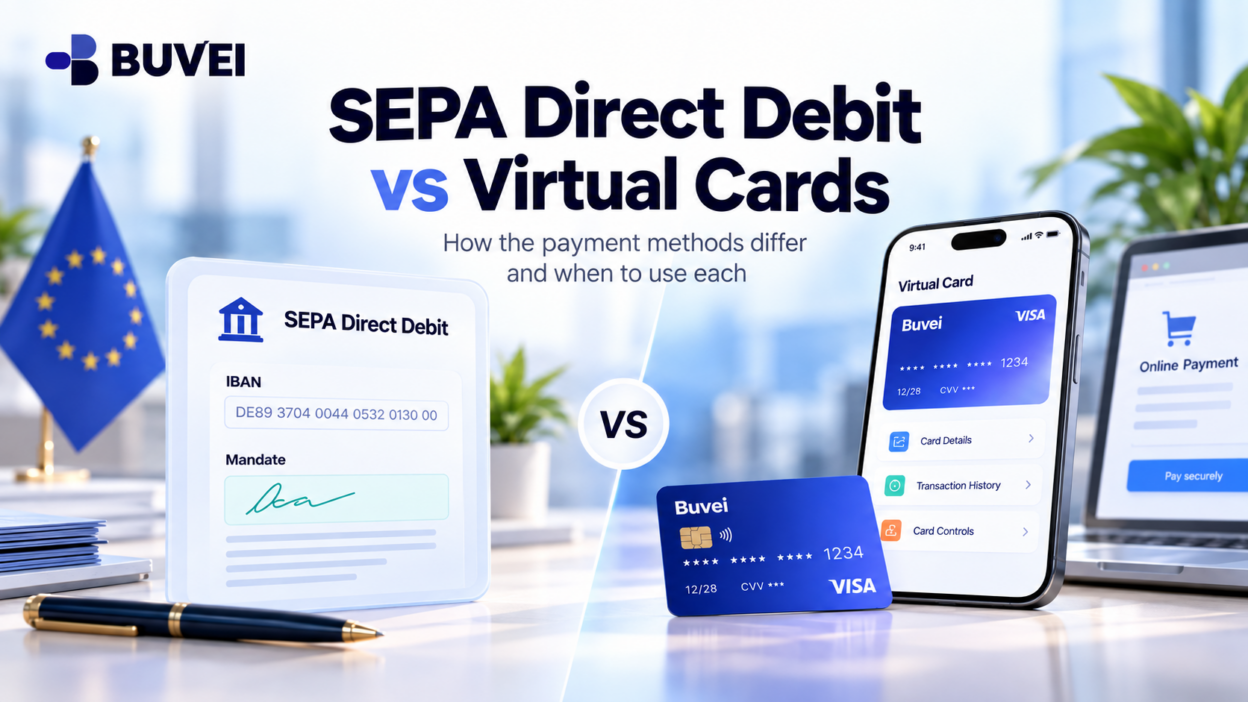
A European software supplier offers two ways to renew a subscription: save a payment card or sign a SEPA Direct Debit mandate.
If your company already uses virtual cards for online spending, a natural question is:
Can a virtual card be used for SEPA Direct Debit?
The answer is no.
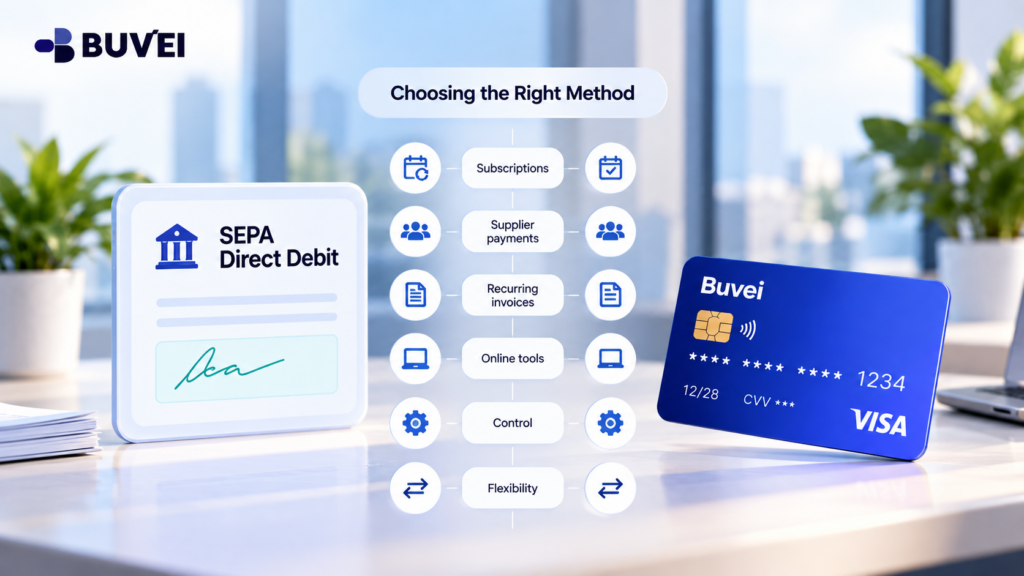
A virtual card and a SEPA Direct Debit mandate are two different payment arrangements. They use different identifiers, follow different collection processes, and give the payer different controls.
A virtual card works only where the supplier offers a compatible card payment route. It is not an IBAN and cannot replace a bank account that supports SEPA Direct Debit.
Virtual Card vs SEPA Direct Debit
For a card subscription, the business provides a card credential through the merchant’s supported checkout.
The merchant may then submit eligible future charges according to the customer agreement and applicable card rules.
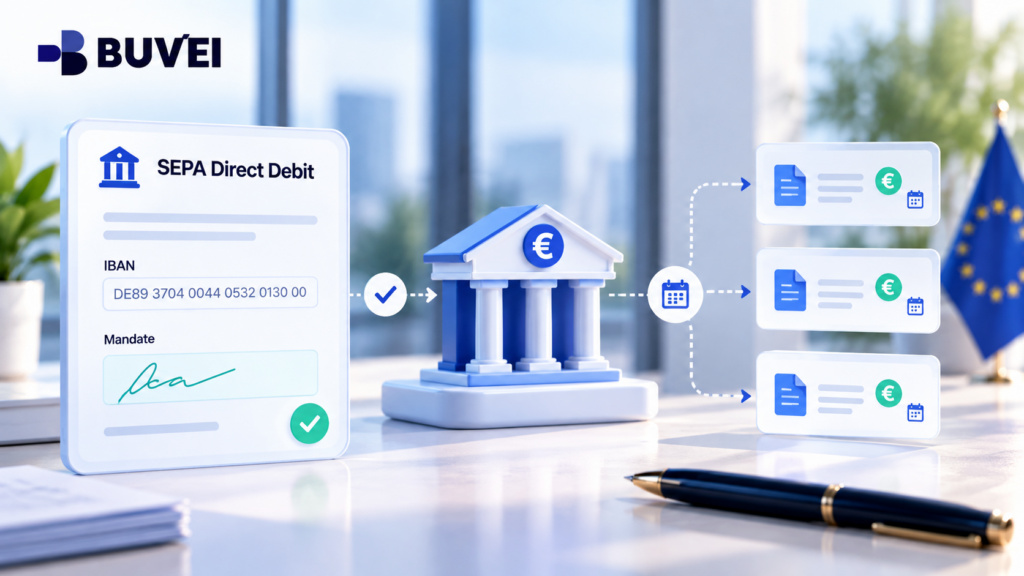
For SEPA Direct Debit, the business authorizes a named creditor to debit a euro-denominated payment account under an agreed mandate.
That means the payer provides:
- An eligible IBAN
- Mandate information
- The required authorization
- Any bank-side confirmation required by the scheme
A card number and CVV cannot be entered in place of an IBAN.
What a SEPA Mandate Actually Authorizes
A mandate is more than a billing form.
It authorizes a specific creditor to request money from the payer’s bank or payment account under the chosen SEPA Direct Debit scheme.
Before approving one, check:
- Creditor legal name
- Creditor identifier
- Unique mandate reference
- Payer legal entity
- IBAN
- Whether the mandate is one-off or recurring
- Signature or approval method
- Related contract and billing terms
Keep a copy of the mandate in the company’s vendor records.
The company should also confirm that the creditor named on the mandate matches the actual supplier or a documented billing agent.
If the invoice entity, product brand, and proposed creditor do not match, ask for a written explanation through an established supplier contact before signing anything.
SEPA Core vs SEPA B2B
The European Payments Council describes two main SEPA Direct Debit schemes:
SEPA Core
Designed primarily for consumers, although it may also be available in some business situations.
SEPA B2B
Designed specifically for business payers.
Both rely on prior authorization through a mandate, but they are not interchangeable.
One important difference is refund treatment.
Under SEPA Core, the EPC states that a payer may request a refund within eight weeks after an authorized collection, and may have additional rights for unauthorized transactions.
Under SEPA B2B, there is no equivalent refund right for an authorized transaction under the scheme, and the payer’s bank must verify the mandate information before collection.
For B2B Direct Debit, the business should confirm that its bank actually supports the scheme and that any required registration or verification steps are complete.
Ask Which Payment Route the Supplier Actually Requires
Do not assume that a supplier saying “SEPA” means the same thing in every case.
Ask:
- Is card payment available for this exact plan?
- Is SEPA Direct Debit required or optional?
- Is the scheme Core or B2B?
- Which legal entity is the creditor?
- What is the creditor identifier?
- What is the mandate reference?
- When will the first collection happen?
- What amount should be expected?
You should also ask your bank or payment account provider whether the account supports that specific SEPA scheme.
A payment account that accepts ordinary SEPA transfers does not automatically support SEPA B2B Direct Debit.
When a Virtual Card Still Makes Sense
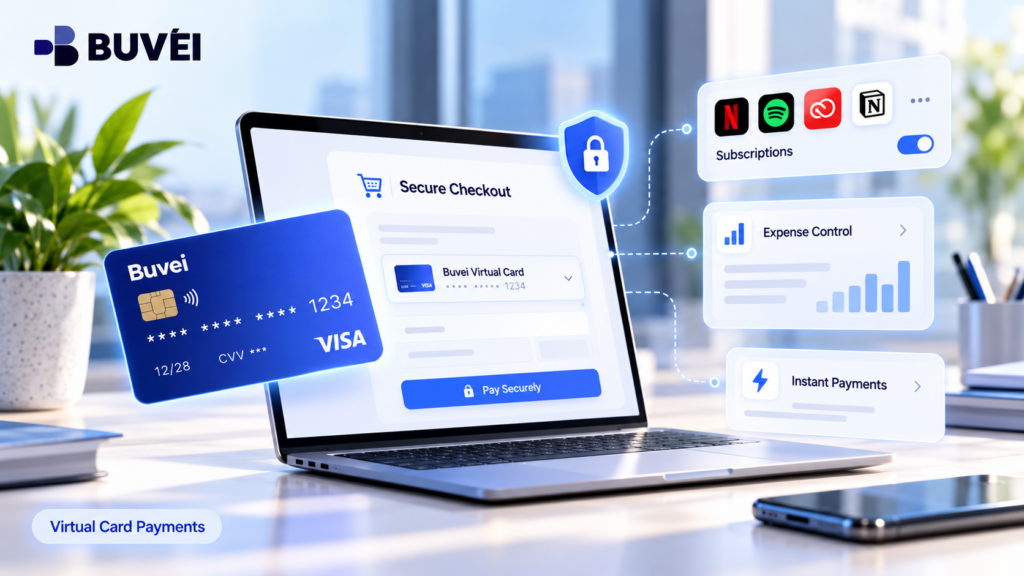
If the supplier offers card payments and the card is eligible, a dedicated virtual card can still be useful.
For example, it can help a business:
- Separate one supplier from other recurring spend
- Track card-side activity more clearly
- Apply available spending controls
- Reconcile SaaS payments more easily
This can work well for self-service SaaS plans or suppliers that continue to support card checkout.
Where Buvei virtual cards are accepted by the merchant, businesses can use card controls and transaction history to manage approved supplier payments more clearly.
But if the supplier requires SEPA Direct Debit for the selected plan, a virtual card is not a workaround.
The business will need an appropriate SEPA-capable payment account and the required authorization process.
Switching From Card to SEPA
A common risk appears when a business changes from card billing to SEPA Direct Debit.
For example, a supplier may accept card payments for a smaller team plan but require SEPA B2B for an enterprise agreement.
During the transition, confirm:
- The last billing period charged to the card
- The first billing period collected through SEPA
- The new creditor entity
- The mandate reference
- The first SEPA collection date
- Whether the previous card billing instruction has been stopped
This matters because both payment routes can remain active during a transition.
If the business does not confirm the cutover date, it may be difficult to tell whether two charges relate to separate service periods or are duplicates.
Avoid Duplicate Payments
If a SEPA collection fails, do not immediately pay the same invoice by card.
A direct debit may fail because:
- The mandate was not registered correctly
- The IBAN was incorrect
- The bank does not support the scheme
- Funds were insufficient
- The bank rejected the collection
- Additional verification was still required
Before using a card as a backup, ask the supplier whether the failed collection will be retried.
If you make a manual card payment, obtain written confirmation that the same invoice will not also be collected through SEPA later.
This is especially important during the transition between payment methods.
The Contract and the Payment Method Are Separate
Changing or blocking a payment method does not automatically cancel a commercial obligation.
For example:
- Revoking a SEPA mandate may stop a future collection
- Freezing a virtual card may prevent a card payment
- Removing a saved payment method may stop a checkout attempt
But none of those actions automatically terminate a valid supplier contract.
To cancel a subscription or service, follow the supplier’s required commercial cancellation process.
Payment permissions and contractual obligations should be managed separately.
Security When a Mandate Request Arrives by Email
A legitimate supplier may send a SEPA mandate by email.
But a fraudulent sender could also create a convincing form.
If a new mandate appears unexpectedly, verify it independently.
Check:
- The supplier through its existing portal
- A known phone number or contact
- The legal creditor name
- Creditor identifier
- Payer legal entity
- Intended IBAN
- Authorized company signers
Do not rely only on the contact details inside the unexpected email itself.
If the bank requires a separate B2B confirmation, complete that through the bank’s trusted channel.
What to Keep in Your Records
For SEPA Direct Debit, retain:
- Signed mandate or digital confirmation
- Creditor identifier
- Mandate reference
- Scheme type
- Masked payer IBAN
- Invoice
- Collection date
- Bank debit record
For card payments, retain:
- Merchant payment agreement
- Masked card reference
- Checkout or authentication confirmation
- Invoice
- Card transaction record
This makes it easier to connect the visible payment record to the actual supplier and contract.
It is especially useful when the supplier’s legal billing entity differs from the product name shown to employees.
A Simple Decision Before You Pay
Before choosing either route, confirm:
- Which payment methods the supplier supports
- Which method applies to your specific plan
- Who the legal creditor is
- Whether SEPA Core or B2B is involved
- Which account or card will be charged
- The expected amount and collection date
- Who is authorized to approve the payment method
- What must be done separately to cancel the service
If the supplier requires SEPA, do not enter a card number in an IBAN field.
If the supplier offers only card checkout, do not send bank details to an unverified contact.
Use the payment route that both the supplier and your authorized payment account actually support.
Final Thoughts
A virtual card and a SEPA Direct Debit mandate are not interchangeable.
A virtual card is useful where a supplier offers a compatible card payment route.
SEPA Direct Debit requires an eligible bank or payment account, an IBAN, and authorization through the relevant mandate process.
For businesses, the safest approach is to keep three things separate:
- The supplier contract
- The payment authorization
- The payment instrument
When those are clearly documented, recurring supplier payments are easier to manage, reconcile, and change without creating duplicate charges or unexpected obligations.