
Dr. Ignacio Carballo, Director of Alternative Finance at Payments and Commerce Markets Intelligence (PCMI), Analyzes 2025 Trends in Payments and E-Commerce in Indonesia
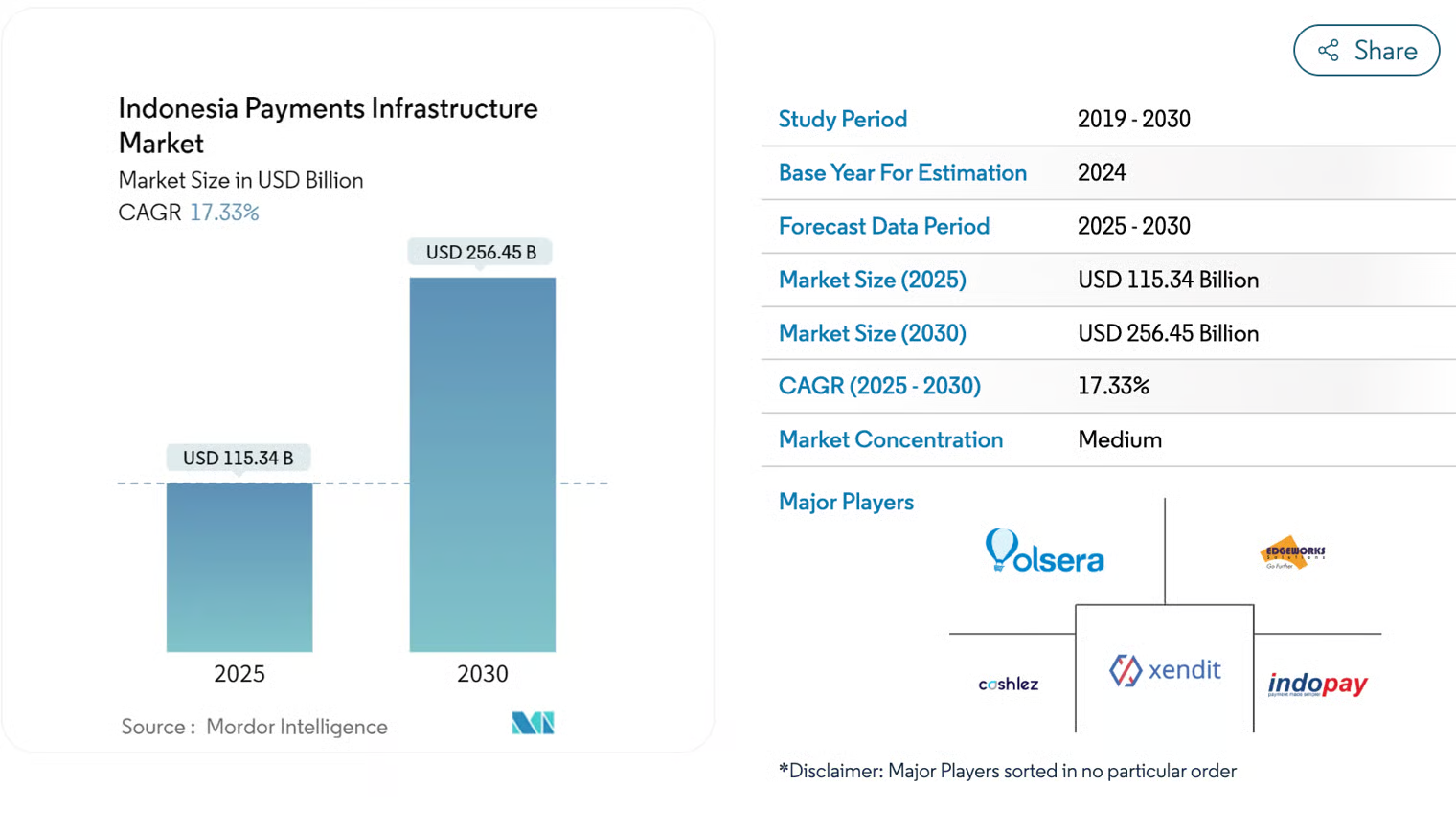
As the largest economy in Southeast Asia—with a population of 278.3 million—Indonesia offers immense opportunities in e-commerce and digital payments. The country's payment and e-commerce landscape is rapidly digitalizing in 2025, driven by government policies, fintech innovation, and evolving consumer behavior. According to Mordor Intelligence, digital payments are expected to see explosive growth with a compound annual growth rate (CAGR) of 17.33%, pushing the market to $115.34 billion by 2025 and $256.45 billion by 2030, making Indonesia one of the most dynamic digital economies in the region.
The COVID-19 pandemic significantly reshaped consumer shopping habits, especially in the retail sector. As a result, cash payments have rapidly declined in Indonesia, while digital payment adoption has accelerated. Although still dominant, the share of cash transactions has dropped from over 70% in 2020 to 51% in 2025.
In terms of e-commerce volume, Indonesia’s market is expected to reach approximately $94.5 billion by 2025, and nearly double to $194.2 billion by 2030, with a robust CAGR of 15.5% in recent years, according to Mordor Intelligence. This growth is fueled by increasing internet penetration, widespread smartphone usage, the rise of the middle class, and the development of digital payment infrastructure, which is steadily reducing reliance on cash transactions.
Leading platforms such as Tokopedia, Shopee, Lazada, and Bukalapak dominate the market, while social commerce via TikTok Shop and Instagram Shopping is rapidly gaining popularity among younger consumers. To protect local businesses, the Indonesian government has taken steps such as blocking certain foreign apps (e.g., China-based Temu) to shield SMEs from low-price competition.

Fintech Innovations and Key Trends
Six major trends are currently shaping Indonesia’s payments and e-commerce landscape:
-
Ubiquity of mobile wallets (e.g., GoPay, OVO, DANA, ShopeePay)
-
Standardization of QR code payments (QRIS)
-
Rise of “Buy Now, Pay Later” (BNPL) solutions
-
Expansion of instant and contactless payments
-
Modernization of merchant infrastructure through mPOS solutions
-
Growing adoption of crypto and blockchain technologies
Key Players in the Payments Ecosystem
Indonesia’s payment ecosystem features a wide range of players:
-
E-wallets: GoPay, OVO, DANA, LinkAja
-
BNPL providers: Kredivo, Akulaku, Atome
-
Payment gateways: Xendit, Midtrans, DOKU
-
Traditional banks: Bank Mandiri, BCA, BRI
Regulation and the Digital Future
Regulatory initiatives, such as Bank Indonesia’s Blueprint for Payment Systems 2025 (Blueprint IPS 2025), aim to enhance financial inclusion, secure transactions, and foster innovation—laying the groundwork for a sustainable digital economy.
Outlook for 2025
Indonesia is positioning itself as a regional leader in digital commerce, marked by sustained e-commerce growth, massive adoption of digital payments, and forward-thinking regulations that are tailored to the challenges and opportunities of the digital age.

Sources: Mordor Intelligence, PCMI, Bank Indonesia, 2024–2025 Industry Reports
👉 Buvei | Your seamless solution for secure and efficient international payments