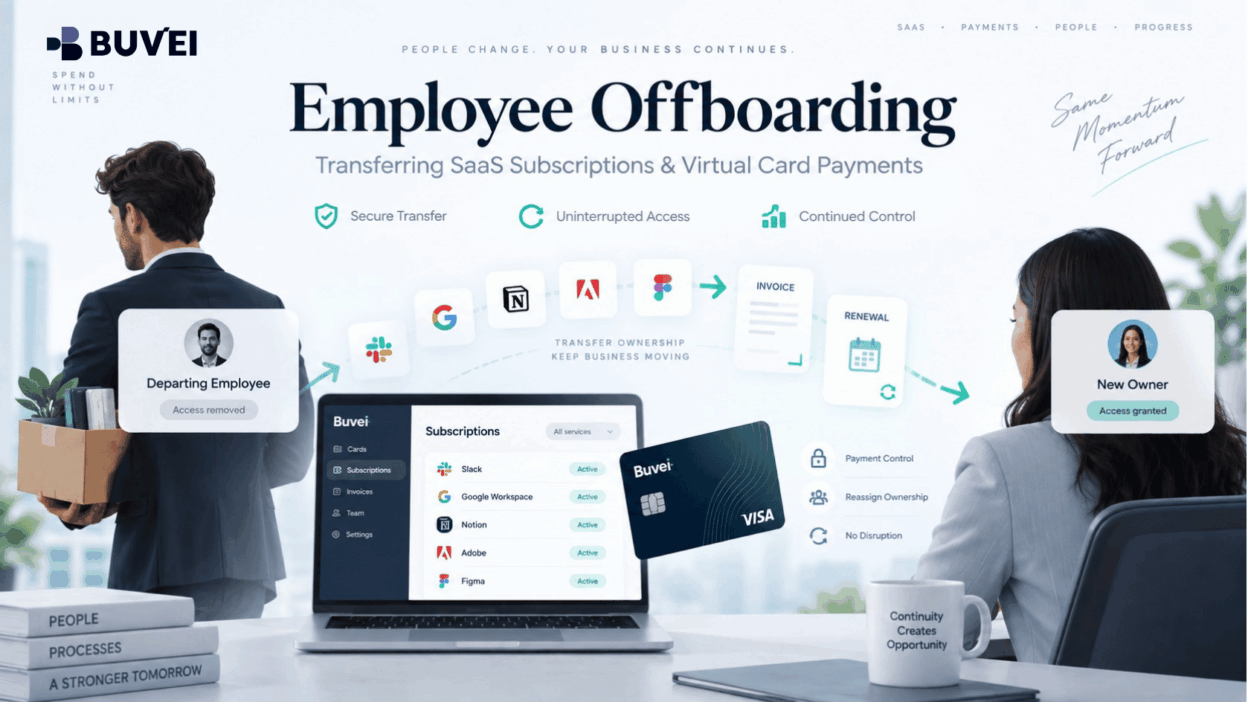
A departing employee can take more than a laptop and an email signature out of a company’s daily workflow. They may also be the only person who knows which account owns an essential software subscription, where its invoices are stored, which virtual card pays for it, and when the next renewal is due.
The card may remain active while the business loses the ability to manage the service around it.
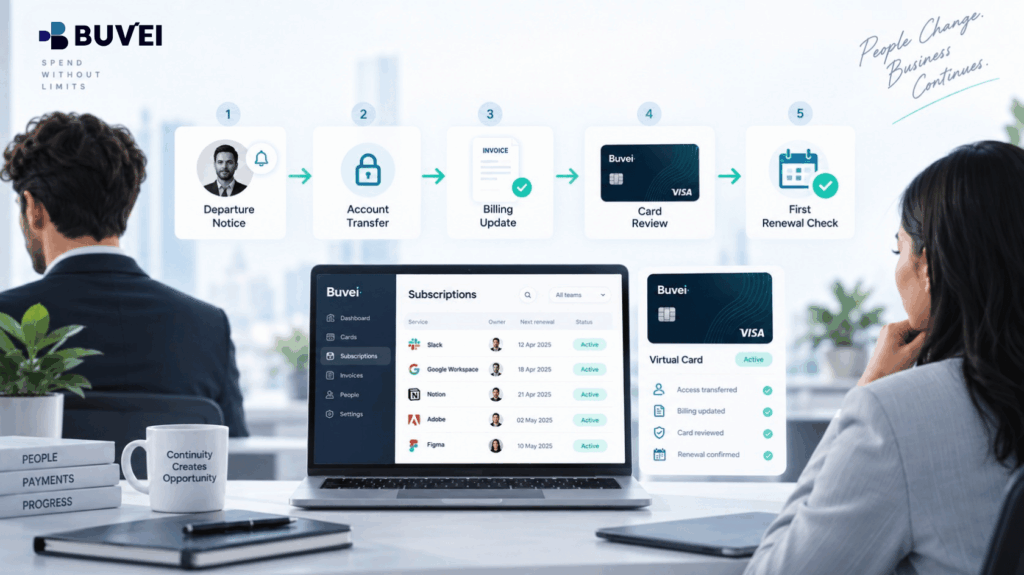
Good offboarding therefore includes payment continuity. The goal is not simply to remove the employee’s access. The company also needs to transfer merchant account ownership, billing responsibility, renewal information, invoices, and authorised card control to a new owner.
That handover should happen without exposing unnecessary card data or leaving personal accounts connected to company spending.
A clean transition moves account ownership, payment responsibility, renewal dates, and supporting records together.
The Subscription Is Not the Same as Its Payment Method
Teams often talk about “the company card for the design tool” as though the card owns the subscription.
It does not.r
The merchant account controls the plan and service access. The payment method authorises charges. The billing profile identifies the purchaser. The employee or team uses the product.
These responsibilities may be controlled by different people.
If the employee’s work email owns the merchant account, changing the virtual card alone does not complete the handover. The new owner may still be unable to cancel the plan, change seats, download invoices, or contact merchant support.
Conversely, transferring the merchant login without reviewing the payment method can leave the former employee’s card allocation or reimbursement arrangement active.
A reliable process treats account access and payment access as two connected workstreams.
Neither should be solved by simply sending card details to the next employee.
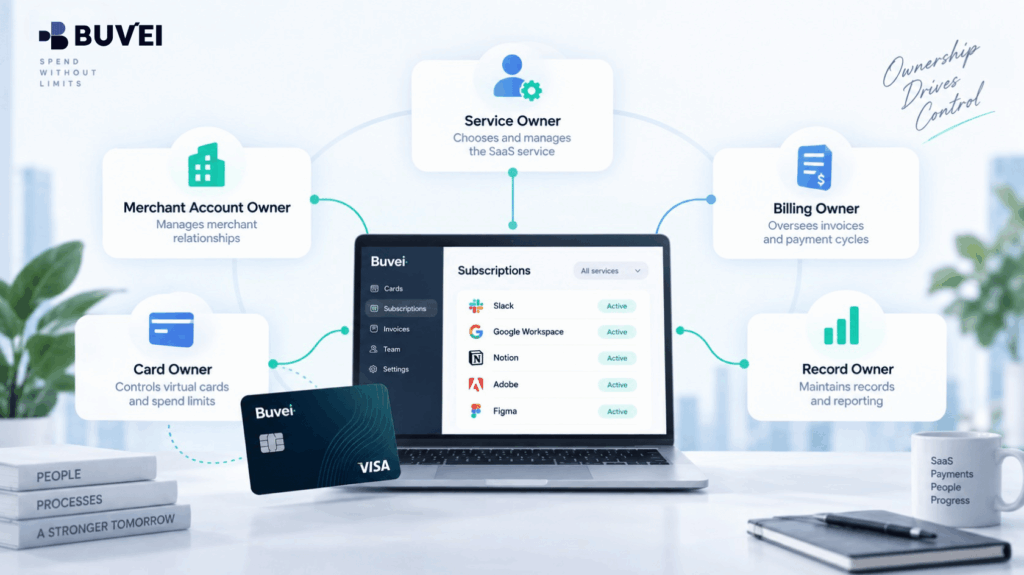
Map the Five Owners Before Changing Anything
| Ownership role | What it controls | What must be transferred |
|---|---|---|
| Service owner | Whether the tool is still needed and who uses it | Business purpose, seats, projects, renewal decision |
| Merchant account owner | Login, plan changes, cancellation, support | Company-controlled email, MFA, recovery options |
| Billing owner | Invoice profile, tax details, payment notices | Legal entity, billing contact, document access |
| Card owner | Card status, funding, limits, transaction review | Authorised provider access and card assignment |
| Record owner | Evidence for accounting and internal review | Invoices, approvals, references, handover notes |
In a small company, one person may hold all five roles. The distinction is still useful because the replacement employee needs to know exactly which responsibilities they are taking over.
In a larger organisation, finance may manage the virtual card, IT may control the merchant login, procurement may own the contract, and an operating team may decide whether the subscription should continue.
Do not assume the departing employee’s manager automatically becomes every owner.
The manager may understand the business need but lack billing permissions. Finance may see the card transaction but not the merchant account. IT may reset the email but not know whether an annual renewal was already approved.
Assign each role explicitly.
Start Before the Employee’s Final Day
The best time to transfer a payment relationship is while the departing employee can still explain it.
A rushed process after the account has already been disabled often leads to incomplete information and unnecessary support requests.
Add subscription ownership to the offboarding checklist as soon as the departure date is known.
Ask the employee to identify services they:
- Purchased
- Administer
- Approve
- Receive invoices for
- Manage on behalf of a team or client
This should include tools paid directly by card, platforms funded through prepaid balances, free trials that may become paid, annual contracts, browser extensions, app-store subscriptions, and services where the employee is only the billing contact.
The process should focus on business information, not personal passwords.
Where possible, the employee should transfer ownership through the merchant’s official admin tools, add a company-controlled administrator, or export an account list.
They should not send passwords, full card numbers, CVVs, or one-time codes through normal messages.
Build a Subscription Handover Register
A useful register should make the next renewal understandable without requiring the new owner to search through old chats or emails.
Keep it simple enough that people will actually maintain it.
Include:
- Merchant and product: the supplier and exact plan.
- Business purpose: which team, client, project, or workflow depends on it.
- Merchant account: company-controlled login, administrator, and billing contact.
- Renewal pattern: monthly, annual, usage-based, prepaid, or manual.
- Expected amount and currency: a realistic range rather than a fixed assumption.
- Virtual card reference: a safe internal label or provider reference, never a spreadsheet of full credentials.
- Invoice location: merchant portal, billing mailbox, or controlled document folder.
- Decision date: when the service should be reviewed before renewal.
- New owner: the person responsible after the handover.
The register should also record unresolved items.
If the merchant does not support ownership transfer, mark the account as requiring migration. If an invoice is missing, assign someone to request it. If the employee used a personal account for company work, treat it as a controlled migration rather than assuming the account was company-owned.
Transfer the Merchant Account Safely
Use a Company-Controlled Identity
Where the merchant allows it, move primary ownership to a company-controlled email address or durable role-based account.
A shared business identity does not mean everyone should receive the password. Access should still be limited, logged, and protected by the company’s normal authentication process.
If the merchant requires a named individual, assign a current authorised employee and add at least one backup administrator where possible.
Update:
- Recovery email
- Recovery phone
- Multi-factor authentication
- Security contacts
- Billing contacts
Confirm that the former employee can no longer reset access after departure.
Preserve Service Data and Permissions
Before removing the employee, transfer any important assets they own inside the service.
These may include:
- Projects
- Files
- Dashboards
- API keys
- Advertising assets
- Licences
- Admin roles
- Cloud resources
- Integrations
Payment continuity is not useful if the company keeps paying but loses access to the content or configuration it purchased.
Some merchants remove data or downgrade access when a user is deleted. Others allow ownership transfer only while both users remain active.
Coordinate with IT and the service owner rather than treating account removal as a finance-only task.
Update Support and Billing Contacts
Change the email addresses that receive:
- Renewal notices
- Failed-payment alerts
- Price changes
- Invoices
- Security notifications
- Account updates
Where practical, confirm that the new mailbox receives a normal notification before the former employee’s account is disabled.
A subscription can fail weeks later simply because every warning continues going to a closed inbox.
Transfer Virtual Card Responsibility Without Exposing Credentials
The new card owner should receive authorised access through the virtual card provider or the company’s established payment process.
They may need visibility into:
- Card purpose
- Card status
- Spending limit
- Available balance
- Renewal range
- Recent transactions
They do not need card credentials sent through public or ordinary internal chat.
If the card was assigned to the departing employee under a business account, review whether it can be reassigned or whether a replacement card should be used.
The answer depends on the provider, card configuration, merchant support for updating saved payment methods, and whether there are any open refunds or pending charges.
Do not close the old card automatically until the payment lifecycle is understood.
If the employee used a personal card and claimed reimbursement, the company cannot simply take ownership of that card.
Instead, replace the payment method with an authorised company option through the merchant account, record the effective transition date, and make sure the employee is not charged after leaving.
Decide Whether to Keep, Replace, Pause, or Cancel
Offboarding is also a useful opportunity to review whether each subscription still deserves funding.
Keep
Keep the existing arrangement when the service is still needed, the merchant account is company-controlled, the billing information is correct, and the current virtual card remains appropriate.
Assign a new owner and verify the next renewal.
Replace the Card
Replace the payment method when the service continues but the old card belonged to the departing employee, was widely shared, or no longer fits the company’s control model.
Update the merchant through its official billing page.
Pause or Downgrade
The team may need time to assess usage, transfer data, or reduce seats.
Follow the merchant’s plan rules and record any date when access or stored data may change.
Cancel
Cancel when the business purpose has ended or a duplicate service exists.
Save the cancellation confirmation and continue monitoring for any final charge or refund.
Freezing a virtual card is not the same as cancelling a merchant contract.
It may stop a charge, but the merchant could still consider the invoice due or suspend the account.
Likewise, cancelling the service does not always remove a stored card immediately.
Both sides of the relationship need to be reviewed.
Work Backward From the Next Renewal
The employee’s departure date is not the only deadline.
A monthly subscription may renew tomorrow, while an annual contract may not be charged for several months.
Work backward from the next billing event and confirm that:
- The service is still approved.
- A current employee can log in and contact support.
- The invoice profile is correct.
- The expected renewal amount and currency are understood.
- The virtual card status, limits, and funding are appropriate.
- The saved payment method has been updated if necessary.
- Renewal and failure notices reach the new owner.
- The first post-handover transaction and invoice are reviewed.
For annual services, set an internal review date well before the merchant’s cancellation deadline.
Do not rely on card expiry or insufficient balance as a reminder.
Handle Open Transactions, Refunds, and Credits
An employee may leave while a refund is pending, a transaction remains authorised, or a merchant account holds prepaid credit.
These items still need an owner even if the subscription itself is cancelled.
Record:
- Merchant reference
- Amount
- Currency
- Expected timeline
- Card or account involved
- Person responsible for follow-up
Keep the old card identifiable until the provider’s and merchant’s processes are complete.
Closing a card immediately can make support more difficult, although the exact effect on a refund depends on the provider and payment route.
Merchant credits also need separate attention.
Funds loaded into a platform may no longer sit on the virtual card.
Check whether the credit expires, can be refunded, can be transferred to a new administrator, or remains tied to the original account.
What to Do If the Employee Has Already Left
Sometimes offboarding only begins after the employee’s access has already been disabled.
Start with the systems the company still controls.
Review:
- Finance records
- Card labels
- Billing mailbox messages
- Password-management records
- Procurement approvals
- Expense claims
- Recent recurring transactions
Build a candidate list before attempting account recovery.
Ask IT whether the employee’s work email can be preserved or redirected under company policy.
Use the merchant’s official account-recovery and ownership-transfer process.
Be prepared to provide evidence such as:
- Contracts
- Invoices
- Company domain control
- Administrator approval
- Business documentation
Do not impersonate the former employee or use personal recovery information without authority.
Prioritise essential services first, particularly identity, domains, security, cloud infrastructure, communication, payroll, and customer operations.
Three Handover Scenarios
A Marketing Employee Owns a Monthly Analytics Tool
The employee’s work email is the only administrator, but finance owns the virtual card.
Before departure, the employee adds a company-controlled operations account as administrator, transfers dashboards, updates billing contacts, and records the next renewal.
Finance keeps the current card because its purpose and control remain appropriate.
The new service owner reviews the first post-handover invoice.
A Developer Used a Personal Card for a Cloud Service
The company reimbursed the developer, but both the cloud account and payment card were personal.
The team transfers or recreates the service under company control, moves workloads through the provider’s official process, adds a company virtual card, and confirms that the personal card has been removed.
The developer’s final reimbursement should cover only legitimate charges before the documented transition.
An Agency Loses the Employee Who Manages a Client Subscription
The client owns the merchant account, while the agency pays under a service agreement.
The departing employee handles both communication and invoices.
The agency assigns a new account manager, confirms client authorisation, transfers merchant access, and keeps the dedicated project card under finance control.
The client and agency should also agree on who receives future invoices and who approves plan changes.
Where Buvei Fits
For businesses managing multiple digital services, virtual cards can make payment ownership easier to organise.
Buvei provides virtual card and global payment solutions that can help businesses separate supported payments by card, service, project, or purpose.
During employee offboarding, authorised users can review available card information such as:
- Card status
- Spending limits
- Transaction references
- Recent merchant activity
- Payment history
This visibility can help teams identify which subscriptions still depend on a particular payment method.
For example, businesses may use separate virtual cards for SaaS subscriptions, advertising platforms, cloud services, AI tools, or other digital operating expenses.
Separating these payment relationships can make it easier to understand which services are affected when ownership moves from one employee to another.
Buvei does not transfer third-party merchant accounts, software data, company email systems, contracts, or invoice ownership.
Those responsibilities still need to be managed directly through the relevant merchant and internal company processes.
Product availability and card-management options may also vary by account and card configuration.
For sensitive payment questions, users should contact support without sharing full card numbers, CVVs, passwords, or one-time verification codes.
A Final Offboarding Checklist
- List every paid, trial, annual, prepaid, and usage-based service connected to the employee.
- Assign service, merchant-account, billing, card, and record owners.
- Move access to a company-controlled identity and update recovery methods.
- Transfer files, projects, admin roles, and service data before removing the user.
- Review whether to keep, replace, pause, downgrade, or cancel each service.
- Record the next renewal date, expected amount range, currency, and review deadline.
- Resolve open charges, refunds, credits, invoices, and personal reimbursements.
- Check the first post-handover renewal and document the result.
Contract Ownership Is Separate From Payment Ownership
Replacing a card does not transfer a contract.
Confirm that the company—not the departing employee—controls the supplier agreement, account email, administrator role, domain, licence seats, billing rights, and cancellation rights.
If the original purchase used a personal account, ask the merchant whether a documented business transfer is available.
Creating a second account can split account history, entitlements, credits, invoices, and permissions.
Review renewal notice periods and minimum terms before changing payment details.
A card replacement cannot cancel a contract, and removing a card may simply create an overdue balance.
Test Access Before the Final Working Day
A handover is incomplete until another authorised employee can actually:
- Sign in
- Complete MFA
- Retrieve invoices
- Update billing contacts
- Contact support
- Manage the service as required
Run that test while the departing employee is still available.
Do not ask them to disclose a personal password or one-time code.
Instead, add a company-controlled administrator and recovery method through the platform’s supported process.
For critical technical services, also verify:
- API keys
- Service accounts
- Deployment permissions
- Domain records
- Data exports
- Integration alerts
Payment continuity is only useful if the team can still operate the service.
A 30-Day Post-Offboarding Review
After the next expected billing events, compare actual charges with the transfer register.
Confirm that:
- Charges match expectations
- Invoices reached the correct mailbox
- No billing notices went to the former employee
- Cards kept open for refunds or final invoices are still needed
- Unexpected subscriptions have not continued unnoticed
Also review low-frequency suppliers.
Annual renewals, domain services, compliance tools, professional memberships, and other infrequent services may not appear in the previous month’s transaction history.
Transaction data alone may not reveal every obligation.
Use an Exception Log for Items That Cannot Move Immediately
Some subscriptions cannot be transferred on the departure date because the merchant requires additional verification, contract amendments, refund completion, or support review.
Record each exception with:
- Reason
- Financial exposure
- Temporary owner
- Next action
- Deadline
- Support reference
- Current status
“Waiting for support” is not enough unless there is also a case number and follow-up date.
Close the exception only after another authorised person can operate the service, billing information is current, and the payment route has been properly documented.
Communicate the Handover to the Right People
Notify the teams that need to know, which may include:
- Finance
- Procurement
- IT
- Security
- Operations
- Legal
The message should identify responsibilities and deadlines, not contain card credentials.
For important suppliers, notify the merchant through established channels when administrator or billing contacts change.
Update internal documentation only after the merchant portal reflects the new ownership.
A spreadsheet marked “done” before the actual account has been updated can create false confidence.
Final Takeaway
Employee offboarding should leave the company with more than a disabled login.
A complete handover gives a current authorised owner control of the service, merchant account, billing profile, virtual card responsibility, renewal decision, and supporting records.
The safest process begins before the employee’s final day, transfers access through official tools, avoids sharing sensitive payment credentials, and reviews the first renewal after the change.
When ownership is clear, the subscription can continue—or end—for a deliberate business reason rather than because a former employee’s email or payment method disappeared.