In the digital age of payments, pre-authorization has become a fundamental transaction mechanism across industries such as hospitality, car rentals, and online bookings. While widely adopted, its underlying processes, risk exposures, and evolving use cases are often misunderstood or underexplored.
This article provides a comprehensive breakdown of pre-authorization: what it is, how it works, where it’s used, the key risks involved, and how leading FinTech players are leveraging it to optimize security and customer experience. It also highlights how Buvei enables smarter pre-authorization flows through embedded finance tools, API automation, and real-time risk intelligence.
-
What Is Pre-Authorization?
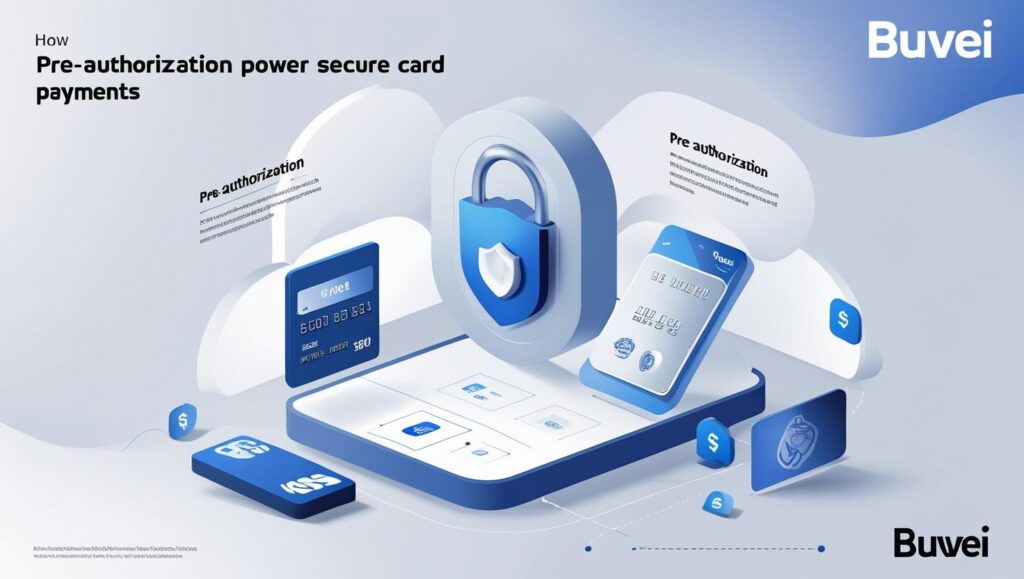
Pre-authorization is a payment process where a merchant temporarily holds a portion of a cardholder’s credit limit to secure a future transaction. Think of it as a “deposit hold” — no funds are transferred, but the amount is earmarked to ensure available balance when the final charge is processed.
Key Attributes:
-
Funds Hold, Not Settlement: No actual funds are withdrawn. The cardholder’s available credit is reduced by the pre-auth amount until the final transaction is completed.
-
Expiration Windows: Most pre-authorizations expire after 15 days (for international cards) or 30 days (domestic), unless manually captured or voided.
- Legacy Overcharge Rules: Older systems allowed merchants to settle up to 115% of the held amount to cover incidental charges. This often led to abuse and has now been restricted by most banks to 100%.
-
How Pre-Authorization Works
A standard pre-authorization lifecycle involves coordination between five parties: the cardholder, the merchant, the acquiring bank, the issuing bank, and the card network (e.g., Visa, Mastercard, UnionPay).
Process Breakdown:
-
Authorization Hold The merchant initiates a pre-auth request (via POS or online gateway), which the issuer verifies before placing a hold on the cardholder’s credit line. An authorization code is returned.
-
Final Capture Upon transaction completion (e.g., hotel checkout), the merchant initiates a “pre-auth completion,” debiting the actual charge and releasing the unused balance.
-
Void or Expiry If the transaction is canceled (e.g., reservation no-show), the merchant should manually void the hold. Otherwise, it will be automatically released after the hold period expires.
-
Key Use Cases Across Industries
Hospitality
-
Eliminates the need for cash deposits at check-in.
-
Enables post-stay billing based on actual consumption (e.g., minibar, late checkout), improving both guest satisfaction and operational efficiency.
Car Rentals
-
Secures collateral for traffic violations or damage.
-
Actual charges are settled after vehicle return, with unused funds released.
Online Travel & Airline Bookings
-
Reduces “no-show” rates by verifying customer intent.
-
Ensures payment capacity without charging until fulfillment.
-
Risk Factors and Fraud Scenarios
While pre-authorization enhances transactional control, it also introduces risks if not properly managed:
-
Credit Card Cash-Out Abuse
-
Exploit: Users preload excess funds and exploit outdated overcharge rules to withdraw more than originally authorized.
-
Impact: Major issuers have reported multi-billion fraud losses in past decades due to this vulnerability.
-
Merchant Fraud & Negligence
-
Holds not released in a timely manner cause consumer frustration and chargeback disputes.
-
Weak controls over international CVV-only pre-auths increase fraud risk.
-
Risk Mitigation Strategies
-
Issuer-Level: Cap settlement amounts to match held funds exactly.
-
Acquirer/PSP-Level: Enforce stricter onboarding for merchants in high-risk verticals.
-
Cardholder Awareness: Encourage verification of authorization types at point of sale.
-
FinTech-Driven Evolution of Pre-Authorization
Innovative financial infrastructure is transforming how pre-authorizations are executed and managed:
-
Predictive Authorization: AI models estimate the final bill and dynamically adjust hold amounts to minimize unnecessary fund locking (e.g., ride-sharing apps).
-
Tokenized Security: Card-on-file transactions leverage tokenization to safeguard card data, reducing fraud exposure.
-
Automated Release via APIs: Integration between merchant systems and PSPs allows pre-auths to be voided instantly after use-case completion (e.g., checkout or cancellation).
-
Buvei: Enhancing Pre-Authorization Through Smart Payment Infrastructure
As a global embedded payments platform, Buvei provides a modern and secure framework for managing pre-authorizations across travel, mobility, and eCommerce verticals. Key differentiators include:
-
API-First Pre-Auth Cancellation: Buvei’s payment stack integrates seamlessly with merchant workflows to automatically void unused holds in real time, improving fund liquidity and customer experience.
-
Real-Time Fraud Intelligence: Advanced risk models monitor pre-auth patterns to detect anomalies and prevent cash-out abuse before it happens.
-
Full Tokenization Support: Buvei supports tokenized pre-authorization using dynamic virtual cards, ideal for privacy-first and one-time-use cases across platforms.
By partnering with Buvei, businesses can simplify the complexity of pre-authorization while elevating operational control, compliance, and trust.
-
Final Thoughts
Pre-authorization remains a critical component of modern card-based payment systems — especially in industries where delayed settlement is the norm. As fraud tactics evolve and consumer expectations rise, financial platforms must go beyond static holds.
With the right technology stack, businesses can turn pre-authorization into a frictionless, secure, and customer-friendly process. Buvei is at the forefront of that shift — combining programmable payments, tokenization, and intelligent risk tools into a unified solution for global merchants.