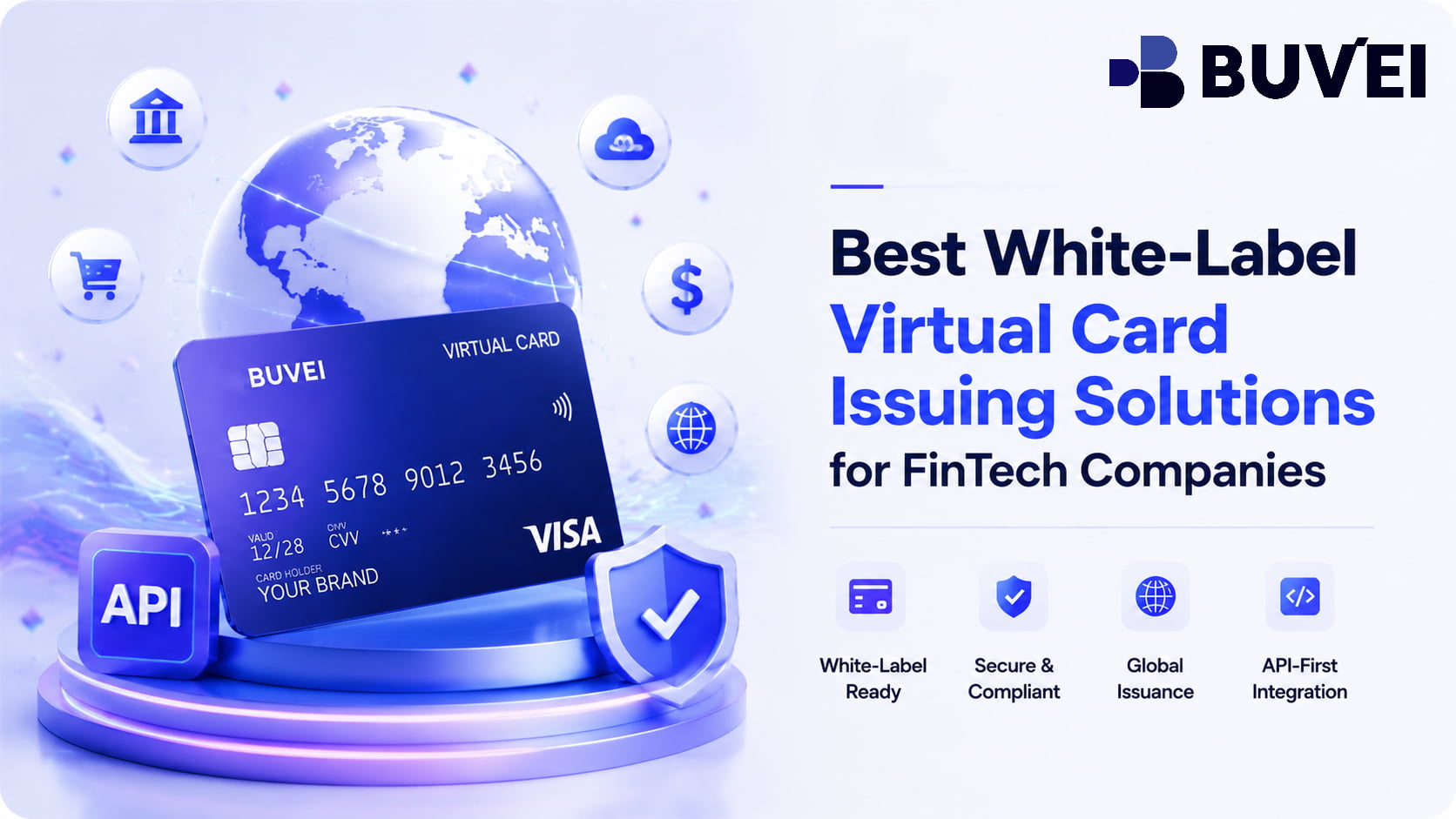
White-label virtual card solutions allow FinTech companies to launch branded payment products without building card issuing infrastructure from scratch. However, creating a reliable virtual card program requires much more than generating digital card numbers.
The real challenge lies behind the card itself — connecting issuing infrastructure, payment networks, compliance systems, transaction monitoring, and settlement processes into one scalable solution.
The best white-label virtual card issuing solutions allow FinTech companies to launch branded Visa and Mastercard virtual cards faster.
Instead, these platforms remove the need to build complete issuing infrastructure internally.
Moreover, these platforms provide the technology needed for issuing, API integration, risk management, and global payment operations.
Key Capabilities of a White-Label Virtual Card Platform
Flexible Virtual Card Issuing for Different FinTech Business Models
In practice, FinTech companies often require different types of virtual card products depending on their customers and business models.
For example, a digital wallet may need customer-facing payment cards, while a SaaS platform may require virtual cards for subscriptions, employee spending, or business expenses.
A strong white-label issuing platform should support branded Visa and Mastercard virtual cards, flexible card configurations, and different user scenarios across consumer, business, and platform-based applications.
As a result, this flexibility allows companies to build payment products that fit their existing ecosystem instead of adapting their business model around limited card infrastructure.
Multi-Region BIN Support for Global Payment Operations
For companies operating across multiple markets, payment acceptance can depend on regional card infrastructure and transaction environments.
As a result, a multi-region BIN structure gives businesses access to issuing options designed for different markets.
In particular, this capability is especially valuable for companies managing:
- Cross-border payments
- SaaS subscriptions
- Digital advertising payments
- Global e-commerce transactions
Compared with single-region issuing models, multi-region BIN support provides greater flexibility when businesses need to serve customers across different geographic markets.
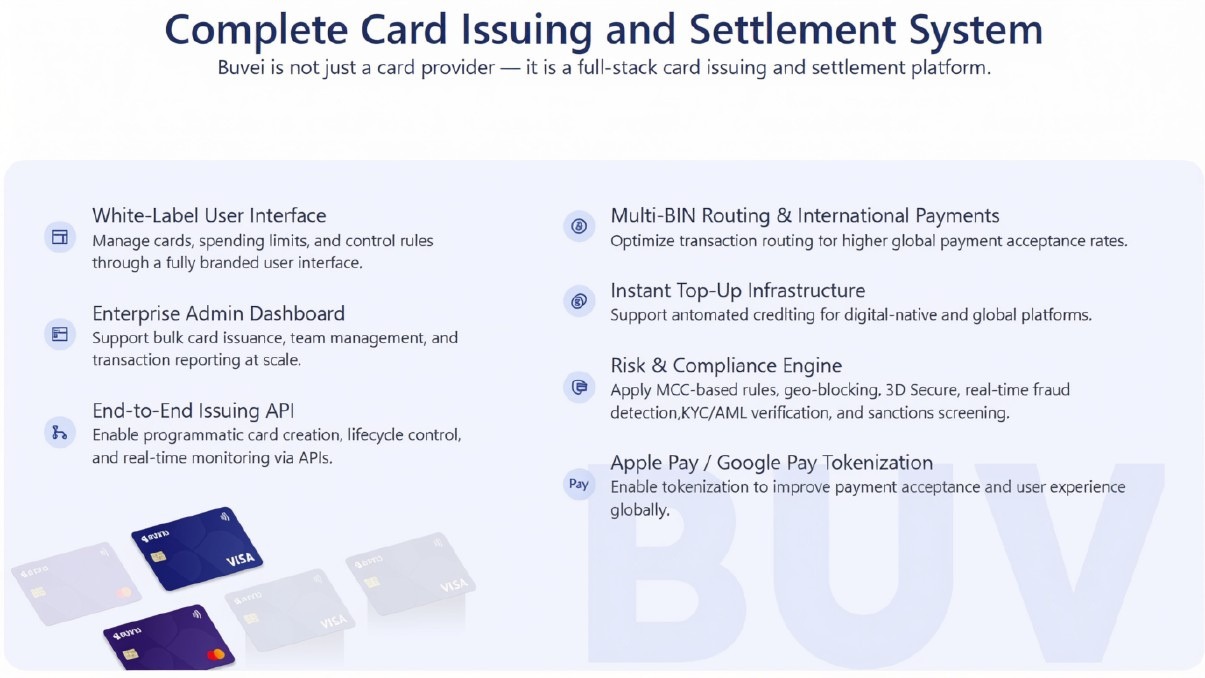
For example, BUVEI supports multi-region BIN options across key markets, including the US, UK, Hong Kong, Singapore, and other regions, helping businesses create more adaptable global virtual card programs.
White-Label Virtual Card API Infrastructure for Embedded Finance
Today, for many FinTech companies, virtual cards are not a standalone product. They are integrated into a larger financial platform or customer experience.
A payment platform may need automated card issuance, while a digital wallet may require real-time transaction updates within its own application.
For this reason, a reliable virtual card API should support essential functions such as:
- Instant card issuance
- Card lifecycle management
- Transaction monitoring
- Real-time notifications
BUVEI provides API-based virtual card infrastructure that enables businesses to connect card functions directly with their platforms and manage card operations programmatically.
Enterprise Controls and Risk Management for Virtual Card Programs
As virtual card programs expand, businesses need stronger control over users, spending activity, and transaction security.
Important capabilities include:
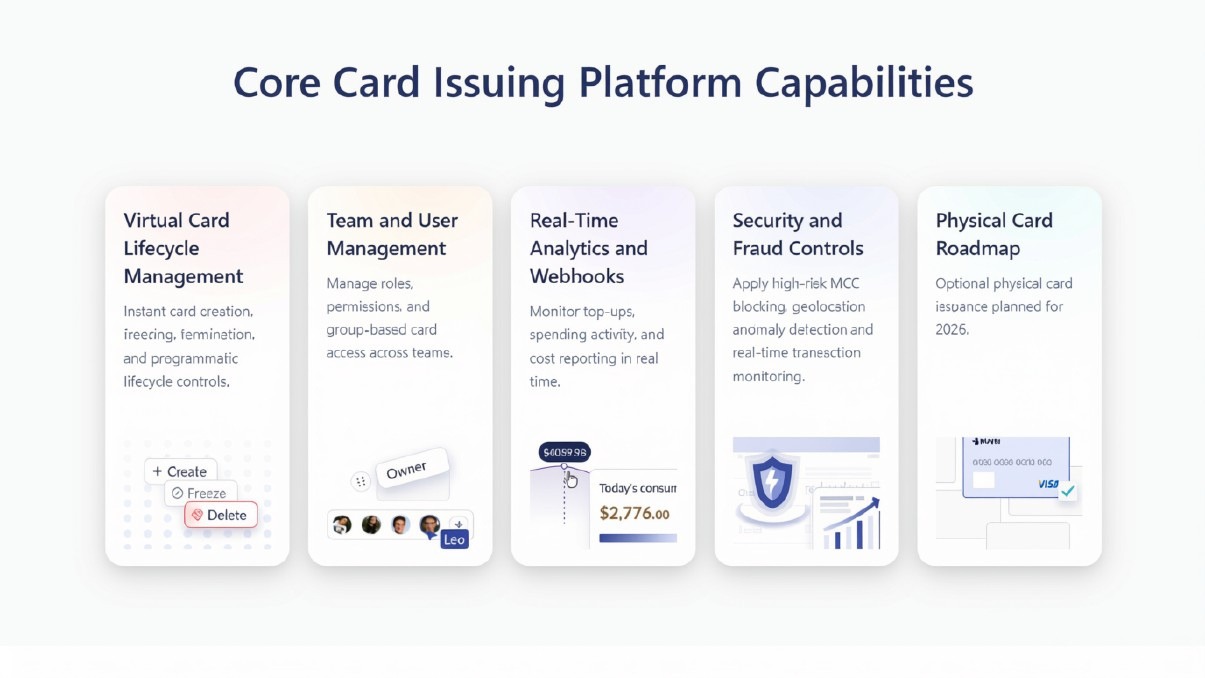
- User permissions and team management
- Spending limits and transaction controls
- Administrative dashboards and reporting
- KYC/AML verification
- Fraud monitoring
- MCC-based restrictions
Therefore, these features help companies manage complex card programs while maintaining visibility over transactions and user activity.
BUVEI provides enterprise-grade management and risk control capabilities that support secure virtual card operations at scale.
The platform also supports Apple Pay and Google Pay tokenization, enabling more flexible payment experiences for end users.
White-Label Virtual Card Solutions for Different FinTech Business Models
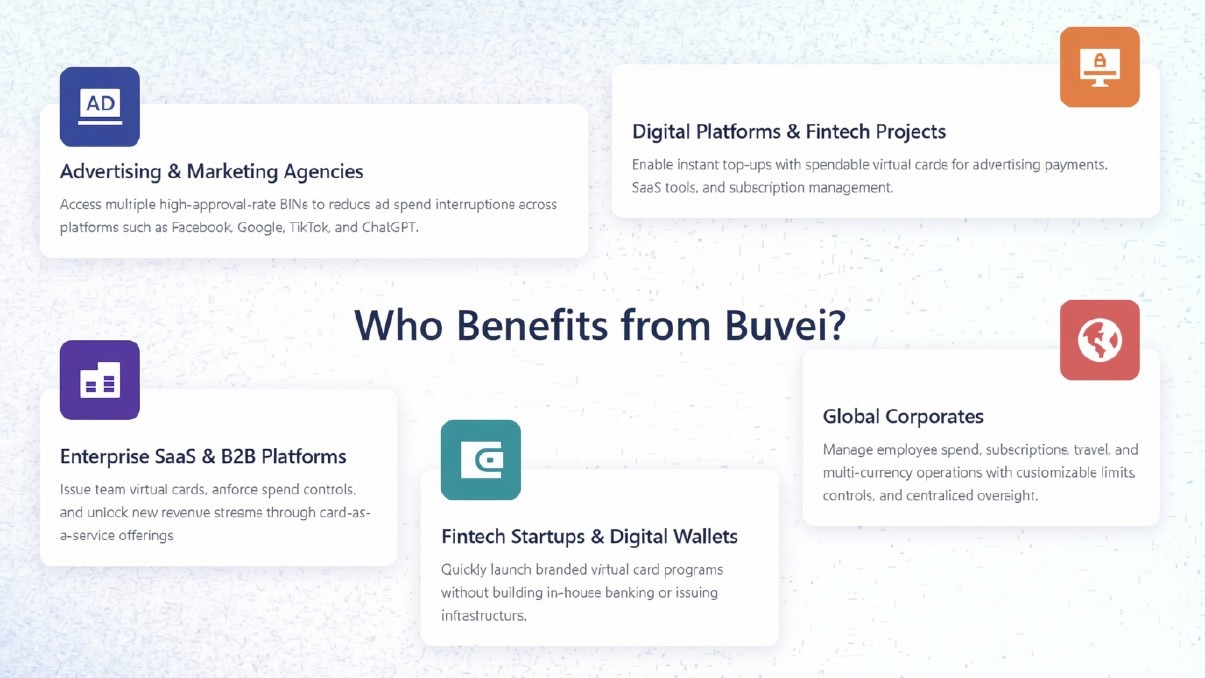
Virtual Card Solutions for Digital Wallet Providers
Digital wallets are increasingly expanding beyond account management and money transfers by adding payment capabilities.
A white-label virtual card solution allows wallet providers to offer branded payment cards, manage customer spending controls, and create a more complete financial ecosystem without developing card infrastructure internally.
Virtual Card Infrastructure for Payment Service Providers
Payment service providers can use white-label virtual card infrastructure to expand beyond traditional payment processing.
Additionally, virtual cards can support business payments, corporate spending solutions, and merchant-focused financial products. As a result, PSPs can provide additional services while using existing issuing infrastructure.
Virtual Cards for SaaS and Business Finance Platforms
SaaS companies are increasingly adding embedded financial services to their platforms.
Virtual cards can support subscription payments, employee expenses, vendor payments, and business spending management, helping SaaS providers offer more complete financial solutions to their customers.
How to Evaluate a White-Label Virtual Card Provider
Review Issuing Coverage and Payment Capabilities
The issuing foundation directly affects where cards can be used and how reliably transactions are processed.
Before selecting a partner, FinTech companies should evaluate:
- Visa and Mastercard availability
- Regional BIN coverage
- Payment acceptance capabilities
- Card program flexibility
A provider with broader issuing capabilities can better support international expansion and different customer requirements.
Evaluate API Integration and Technical Capabilities
For businesses building embedded finance products, API capability determines how easily virtual cards can become part of an existing platform.
Companies should review:
- API documentation
- Automation capabilities
- Reporting functions
- Webhook support
A flexible API infrastructure allows businesses to create smoother user experiences and automate card operations.
Consider Operational Support and Long-Term Scalability
Launching a card program is only the beginning. Businesses also need reliable operational infrastructure as transaction volumes increase.
Important considerations include:
- Transaction monitoring
- Reporting tools
- Settlement support
- Platform reliability
The right issuing partner should provide the operational foundation required to support long-term growth.
White-Label Virtual Card Issuing Solution Comparison
| Capability | Why It Matters for FinTech Companies |
| Visa and Mastercard Issuing | Enables branded payment products |
| Multi-Region BIN Support | Improves global payment flexibility |
| API Infrastructure | Automates card management workflows |
| Enterprise Controls | Supports user and spending management |
| Compliance Tools | Helps maintain secure operations |
| Digital Wallet Support | Improves payment experiences |
Why FinTech Companies Choose BUVEI for White-Label Virtual Card Solutions
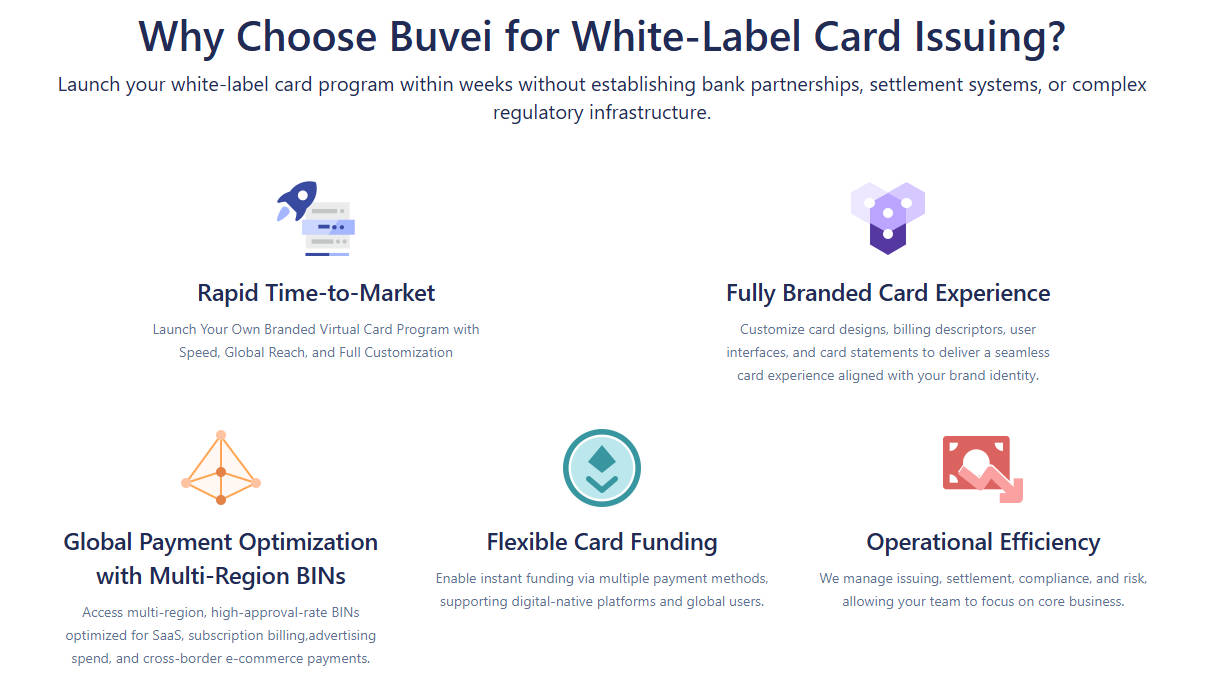
BUVEI provides a full-stack white-label virtual card platform and issuing solution designed for FinTech companies that want to launch and scale branded payment products.
Instead of building issuing infrastructure internally, businesses can use BUVEI’s existing platform capabilities, including:
- Visa and Mastercard virtual card issuing
- Multi-region BIN capabilities
- API-based card management
- Enterprise dashboards
- Spending controls
- KYC/AML and risk management
- Settlement infrastructure
- Apple Pay and Google Pay tokenization
With flexible issuing infrastructure and enterprise-grade payment management capabilities, BUVEI helps FinTech companies, digital wallets, SaaS platforms, and payment providers create scalable virtual card programs.
Conclusion
Choosing the right white-label virtual card issuing solution requires more than comparing card creation features.
FinTech companies should evaluate the complete issuing ecosystem, including payment coverage, API capabilities, compliance controls, risk management, and operational support.
The right platform enables businesses to launch reliable virtual card products while maintaining the flexibility needed for future growth.