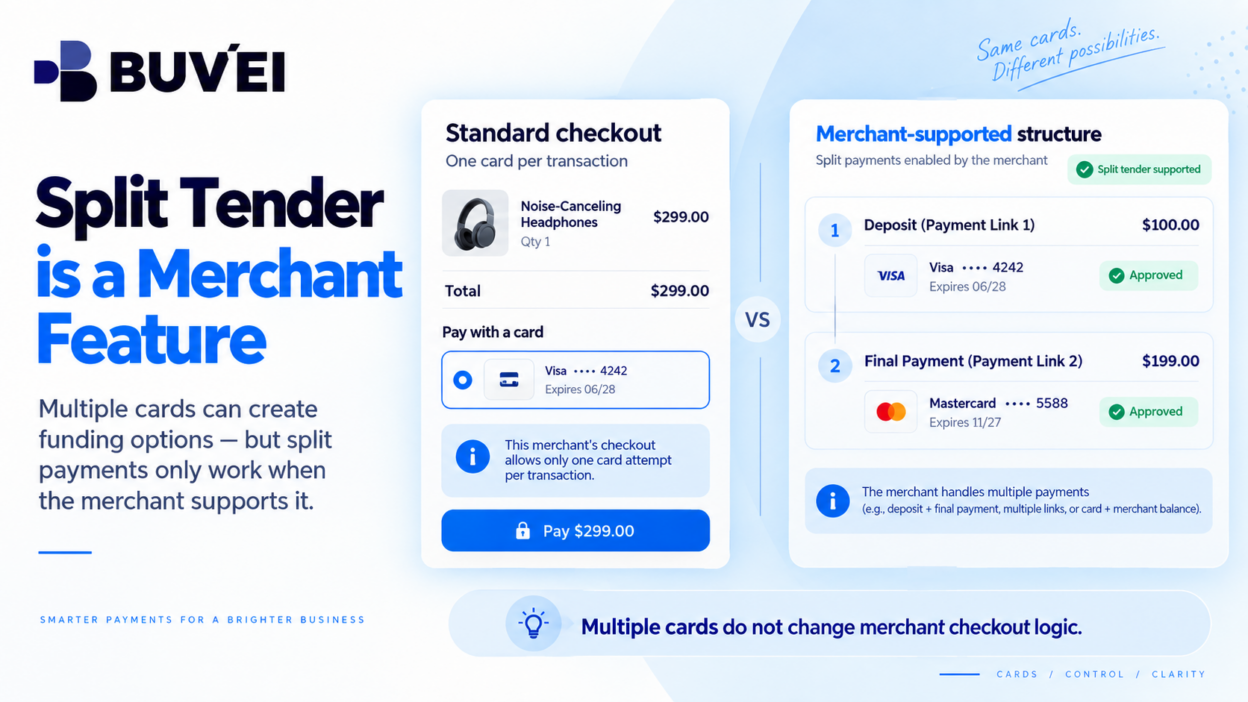
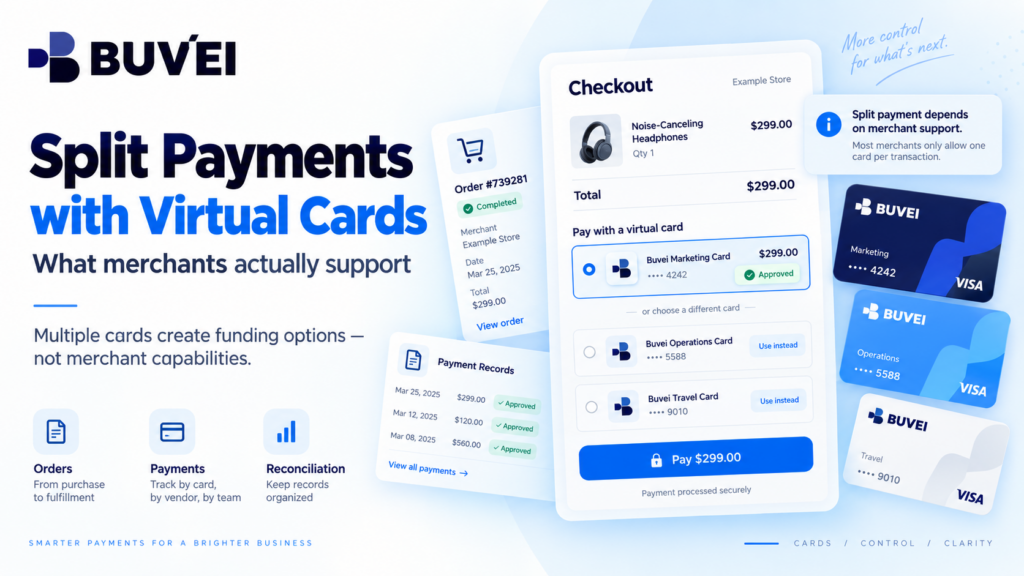
Having multiple virtual cards does not automatically mean you can combine them to pay for one online order.
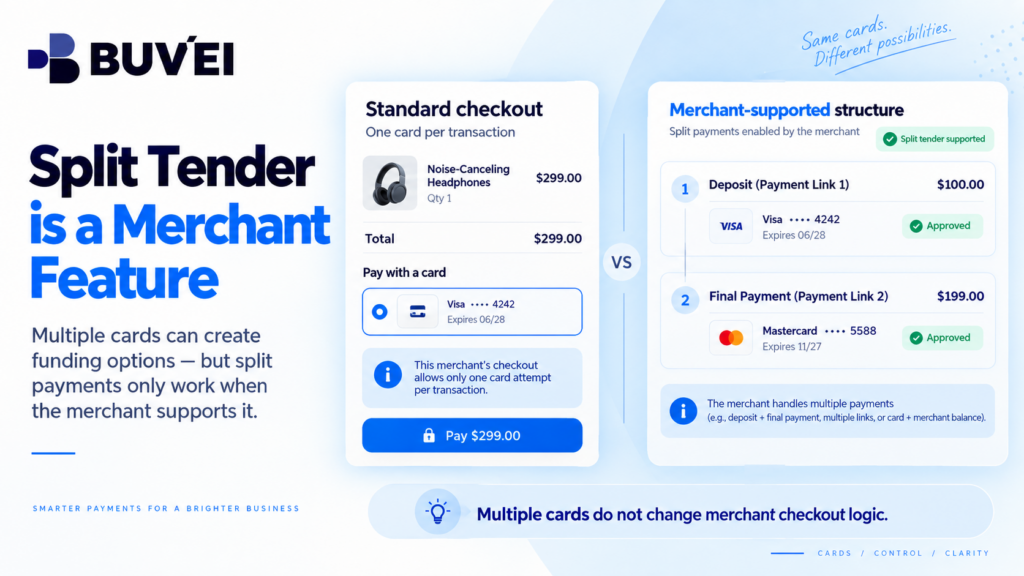
A true split payment, sometimes called split tender, depends primarily on the merchant's checkout and payment structure. If the merchant only accepts one card per transaction, having two or more virtual cards does not change that checkout logic.
This distinction matters because virtual cards can give you more control over how funds are allocated, but they cannot force a merchant to accept multiple cards for one purchase.
Understanding what the merchant actually supports can help avoid failed payments, duplicate attempts, and unnecessary reconciliation problems.
What Is a Split Payment?
A split payment happens when a merchant explicitly allows one purchase to be paid using two or more payment methods.
For example, a checkout might support:
- two different cards,
- card plus account balance,
- deposit plus final payment,
- or another merchant-approved combination.
However, most standard online card forms are designed to accept one card per payment attempt.
If the purchase total is €900 and one card only has €500 available, the checkout will usually not charge €500 and automatically ask for another €400 from a second card.
Instead, the payment attempt may simply fail unless the merchant has built a supported split-payment flow.
Before funding or issuing multiple cards for the same purchase, check whether the merchant actually supports split tender.
Can You Use Two Virtual Cards for One Purchase?
Sometimes — but only when the merchant supports it.
The important distinction is:
Multiple cards give you multiple payment instruments. They do not change the merchant's checkout rules.
If a checkout only accepts one card, switching between different virtual cards does not turn it into a multi-card payment.
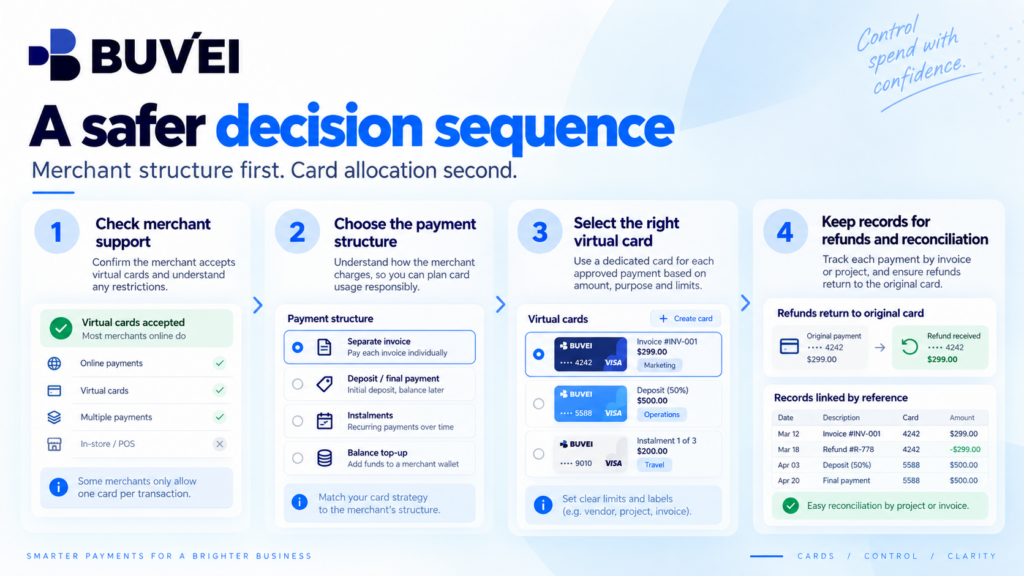
This is why it is better to confirm the payment structure first and choose the cards second.
For example, if a merchant officially supports two separate payment links, you may be able to use one virtual card for each payment.
But if the merchant expects one €900 card charge, two cards with €500 and €400 available do not automatically become one €900 payment.
Split Payments and Separate Invoices Are Not the Same
A merchant may agree to divide one commercial purchase into multiple invoices or payment links.
For example:
- 40% deposit,
- 60% final payment.
That creates two separate transactions, not one card transaction split between two cards.
The same applies to deposits and milestone payments.
A supplier may request a booking deposit first and charge the remaining amount later. Each payment has its own amount, timing, transaction reference, and possibly different refund conditions.
If the merchant officially supports this structure, separate virtual cards can be used for the separate approved payments.
The key is that the commercial structure must exist first.

Instalments Are Also Different from Split Tender
An instalment plan divides a purchase into scheduled payments.
It is not the same as retrying a failed full payment using smaller amounts.
For example, a course provider may officially charge:
Month 1: Payment 1
Month 2: Payment 2
Month 3: Payment 3
Each payment is part of the merchant's agreed instalment plan.
If a merchant offers instalments, follow that official process rather than trying to recreate the same result manually with repeated card charges.
Merchant Balance Can Create Another Payment Structure
Some platforms allow users to add money to an internal balance or wallet before making a purchase.
In that case, multiple card payments may be used to fund the merchant balance.
The final purchase is then paid from the platform balance.
This is different from directly splitting one card transaction across multiple cards.
For example:
Card A → platform balance
Card B → platform balance
Platform balance → final purchase
The two card transactions are funding events, while the final merchant order is paid using the stored balance.
Before using this model, check how unused funds, withdrawals, and refunds are handled by the platform.
Multiple Cards Can Mean Multiple Currencies and Costs
If different cards use different billing currencies or pricing structures, splitting a commercial payment can make reconciliation more complicated.
For example, one part of an invoice may settle in EUR while another card records its transaction in a different ledger currency.
Instead of comparing only the total invoice amount, review each payment separately:
- transaction amount,
- billing currency,
- exchange rate where applicable,
- fees,
- and final posted amount.
This makes the relationship between the original purchase and each individual card transaction easier to understand.
Authentication Happens Separately for Each Payment
Every card payment is processed as its own transaction.
That means each partial payment can have its own:
- authentication step,
- merchant risk review,
- approval,
- or decline result.
Success on the first payment does not guarantee that the second payment will also succeed.
For example, a deposit may be approved successfully, while the later final payment may require another authentication step.
When a purchase involves several transactions, keep the reference for each payment rather than treating them as one combined card event.
Refunds Usually Follow the Original Payment Paths
If a merchant processes several separate card payments, refunds normally return through those original transaction routes.
For example:
Payment 1 → Card A
Payment 2 → Card B
If the purchase is later cancelled, the merchant may issue:
Refund 1 → Card A
Refund 2 → Card B
rather than sending the whole amount to one preferred card.
This is why it is useful to retain each card transaction reference until the purchase, delivery, and refund process is fully complete.
Keep a Clear Link Between the Purchase and Each Payment
One purchase can sometimes connect to several:
- invoices,
- card debits,
- deposits,
- instalments,
- and refunds.
Without a common reference, those records can appear unrelated.
For business reconciliation, it can help to use the same order, supplier, or project reference across internal records and card labels where appropriate.
For example, finance may need to connect:
1 supplier invoice → 2 card payments → 2 receipts → 1 approved purchase
Keeping those records linked makes future review much easier.
Avoid Trying to Manufacture a Split Payment
Repeatedly changing cards or asking a merchant to run random amounts is not a reliable way to create a split payment.
It can lead to:
- duplicate payment attempts,
- duplicate orders,
- merchant risk controls,
- unclear refund paths,
- and more difficult reconciliation.
The original article's recommendation is the right one: use a merchant-approved structure with exact amounts.
Better options may include:
- a revised invoice,
- separate payment links,
- an official deposit arrangement,
- or a documented instalment plan.
If none of those options exists, one adequately funded card may be simpler than an improvised split.
How Buvei Can Be Used With Split Payment Structures
Subject to the relevant account and card conditions, separate Buvei virtual cards can help organize approved payments across different suppliers, stages, or purposes.
For example, separate cards may help distinguish:
- deposits from final payments,
- different suppliers,
- separate invoices,
- or different project expenses.
However, Buvei virtual cards do not change what the merchant's checkout supports.
The recommended sequence is:
Confirm the merchant's payment structure first → then select or issue the appropriate card for each approved transaction.
Card separation can improve visibility and attribution, but only after the commercial payment structure itself is valid.
A Simple Decision Checklist
Before trying to use more than one virtual card for the same purchase, ask:
- Does the merchant explicitly support split tender?
- Can the merchant issue separate invoices or payment links?
- Is the purchase structured as a deposit and final payment?
- Does the merchant offer an official instalment plan?
- Can an account balance or merchant wallet be used?
- How will refunds return if there are several payments?
- Will different currencies or fees affect reconciliation?
Then choose the simplest documented option that matches the merchant's actual process.
In many cases, one sufficiently funded card is cleaner than trying to create an unsupported split manually.
Keep Payment Details Secure
If a split-payment issue needs to be investigated, support may need details such as:
- Buvei account or user ID,
- merchant name,
- transaction time,
- amount,
- currency,
- and last four card digits.
Avoid sending full card numbers or card security codes through ordinary email or chat.
Also keep in mind that merchant rules, authentication, processing routes, limits, and account eligibility can vary between transactions.
A payment method that works in one checkout does not automatically guarantee the same result somewhere else.
Final Takeaway
Having several virtual cards gives you more flexibility in how funds are organized.
It does not automatically give a merchant the ability to split one transaction across multiple cards.
A genuine split payment exists only when the merchant's checkout or commercial payment structure supports it.
The clearest approach is:
Merchant payment structure first → card allocation second.
That helps reduce failed attempts, duplicate charges, refund confusion, and reconciliation problems.