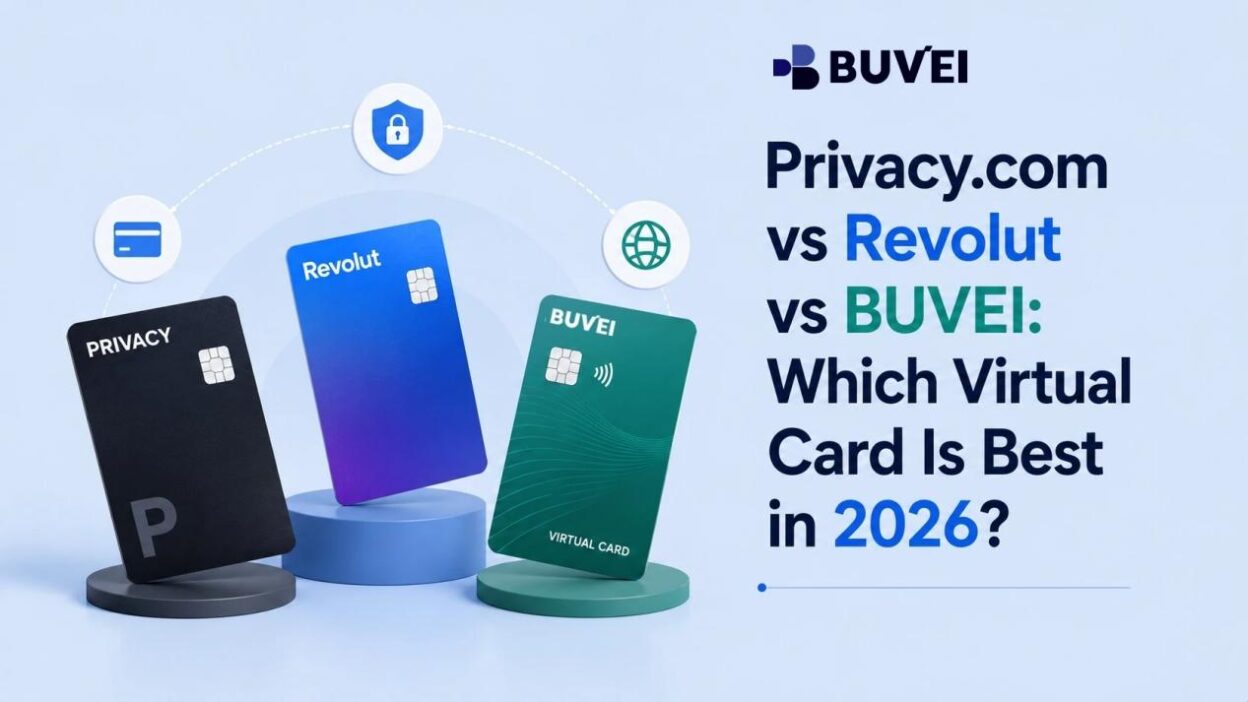
Choosing the right virtual card depends on how you plan to use it. Privacy.com vs Revolut vs BUVEI represents three different approaches to online payments. Privacy.com focuses on payment privacy and spending controls, Revolut combines virtual cards with a broader digital banking ecosystem, while BUVEI takes a more dedicated approach to virtual card management.
In this comparison, we look at spending controls, recurring payments, card management, availability, and practical online payment use cases. Instead of naming one universal winner, we will explain which platform makes the most sense for different payment needs in 2026.
Privacy.com vs Revolut vs BUVEI at a Glance
| Feature | Privacy.com | Revolut | BUVEI |
| Main Focus | Payment privacy and spending controls | Digital banking and international spending | Dedicated virtual card management |
| Virtual Cards | Yes | Yes | Yes |
| Recurring Payments | Supported | Supported | Supported use cases |
| Spending Controls | Strong | Available | Available |
| Card Management | Strong | Strong | Strong |
| International Focus | U.S.-focused | Strong | Global-oriented |
| Business Use | Limited to moderate | Available | Strong |
| Best For | Privacy-conscious users | Banking and travel users | Online payment and virtual card users |
The biggest difference is the role virtual cards play in each product. Privacy.com emphasizes control over individual online transactions, Revolut offers virtual cards as part of a wider financial platform, and BUVEI puts virtual card issuing and management closer to the center of the payment experience.

What Matters When Choosing a Virtual Card?
A virtual card should do more than provide a digital card number. For recurring subscriptions, online services, and business payments, the ability to control and manage the card can be just as important as the payment itself. For this comparison, five factors matter most:
| Factor | Why It Matters |
| Spending Controls | Helps manage budgets and recurring charges |
| Recurring Payments | Keeps subscriptions and ongoing services active |
| Card Management | Makes it easier to control multiple cards |
| Availability | Determines whether the service fits your location |
| Business Use | Important for online expenses and team payments |
These criteria also explain why different users can reach different conclusions. A consumer focused on privacy may value merchant-level controls, while a business that relies heavily on virtual cards may prioritize card management and transaction visibility.
Privacy.com — Best for Spending Controls and Payment Privacy
Privacy.com is built around online payment privacy and granular spending controls. Users can create virtual cards with different limits and controls, making it easier to manage how much can be charged and where a card can be used.
Its spending controls are one of its strongest differentiators. Privacy.com supports limits based on factors such as transactions, monthly spending, annual spending, or total spending. Users can also use merchant-locked cards and manage individual virtual cards separately.
This makes Privacy.com particularly useful for consumers who want more control over online purchases and recurring charges. However, its availability is more U.S.-focused, which can be a limitation for international users or businesses looking for a broader virtual card solution.
Best for: Users who prioritize payment privacy, merchant controls, and granular spending limits.
Revolut — Best for Digital Banking and International Spending
Revolut approaches virtual cards as part of a broader digital banking platform. Its virtual cards can be used for online purchases, while the wider service provides features for international spending, money management, and other financial activities.
For subscriptions and recurring payments, Revolut’s multi-use virtual cards are designed for ongoing charges. Users can also manage cards through the Revolut app, including spending limits and freeze controls.
The trade-off is that virtual cards are one component of a much larger financial ecosystem. If your primary requirement is dedicated virtual card management rather than banking and financial services in one application, a more specialized solution may be a better fit.
Best for: Users who want virtual cards together with digital banking and international spending features.
BUVEI — Best for Dedicated Virtual Card Management
BUVEI takes a more focused approach to virtual cards. Instead of treating virtual cards as one feature within a broader banking application, BUVEI is built around virtual card issuing, management, and online payment use cases.
This virtual-card-first approach can be useful when digital cards are central to how you manage payments. Rather than using one payment credential across multiple services, users can create and manage virtual cards according to different payment requirements.
Card lifecycle management is another important part of the experience. BUVEI provides tools for creating, managing, freezing, and terminating virtual cards, while spending controls can help users set appropriate limits for different payment needs. This is particularly useful when multiple cards are being used across different online services.
Transaction visibility also matters for businesses. BUVEI provides transaction monitoring, reporting, and real-time analytics capabilities that can help users understand virtual card activity and maintain greater visibility over online spending.
The platform is also suited to a range of digital payment scenarios. Businesses paying for SaaS platforms, AI tools, digital services, advertising platforms, and other recurring online services can use virtual cards as part of a more organized payment workflow. Teams can also benefit from card and user management when different employees or business functions need separate payment access.
For businesses with more advanced payment requirements, BUVEI also supports API-based virtual card issuing and management. Multi-region BIN options can further support international online payment use cases without requiring the virtual card function to be tied to a traditional banking relationship.
This makes BUVEI different from both Privacy.com and Revolut. Privacy.com is particularly focused on consumer payment privacy and spending controls, while Revolut combines virtual cards with a broader banking ecosystem. BUVEI puts the virtual card itself closer to the center of the payment workflow.
Best for: Businesses and digital users that need dedicated virtual card management for online payments, recurring services, and business expenses.

Privacy.com vs Revolut vs BUVEI: What Really Sets Them Apart?
The most useful way to compare these three platforms is to look at what each one prioritizes.
| Priority | Best Fit | Main Reason |
| Payment privacy and granular spending limits | Privacy.com | Strong focus on payment controls |
| Digital banking and international spending | Revolut | Broader financial ecosystem |
| Dedicated virtual card management | BUVEI | Virtual cards are central to the platform |
| Online business payments | BUVEI | Focused on virtual card payment workflows |
| Managing multiple virtual cards | BUVEI | Card lifecycle and management capabilities |
| Consumer-focused payment controls | Privacy.com | Strong merchant and spending controls |
Privacy.com is the most natural fit when controlling individual online payments is the primary goal. Its merchant and spending controls make it attractive for users who want to limit exposure when paying online.
Revolut is more appropriate when virtual cards are only one part of a broader financial setup. Its combination of banking, international spending, and virtual cards can make it convenient for users who want multiple financial services in one place.
BUVEI takes the most specialized approach of the three. When virtual cards are a central part of your payment strategy—rather than simply an additional feature—a dedicated virtual card platform can provide a more focused management experience.
Which Virtual Card Should You Choose?
The best option depends on what you expect from your virtual card.
Choose Privacy.com if your priority is payment privacy, merchant controls, and detailed spending limits, particularly if you are within its U.S. availability.
Choose Revolut if you want virtual cards alongside digital banking, international spending, and other financial services.
Choose BUVEI if you want virtual cards to play a central role in managing online payments. It is particularly relevant for SaaS subscriptions, digital services, online business expenses, and users who need to manage multiple virtual cards.
For businesses and digital-first users, the distinction is important. You may not need the platform with the largest number of financial features—you may need the platform that best matches the way you actually use virtual cards.
Frequently Asked Questions
Is Privacy.com better than Revolut?
It depends on your needs. Privacy.com is more focused on payment privacy, merchant controls, and spending limits, while Revolut combines virtual cards with a broader digital banking ecosystem. Privacy.com may be more suitable for users who prioritize granular online payment control, while Revolut can be more useful for users who want broader financial services.
Can Revolut virtual cards be used for subscriptions?
Yes. Revolut’s multi-use virtual cards can be used for recurring payments such as subscriptions. Single-use or disposable virtual cards are generally not appropriate for recurring charges because their payment details are designed for one-time use.
Is BUVEI a good alternative to Privacy.com and Revolut?
BUVEI can be a strong alternative for users whose primary requirement is dedicated virtual card management. Its focus on virtual card issuing, card lifecycle management, spending controls, transaction monitoring, and online payment use cases makes it particularly relevant for businesses and digital users managing recurring online expenses.
Conclusion
Privacy.com, Revolut, and BUVEI each take a different approach to virtual card payments in 2026. Privacy.com stands out for payment privacy and granular spending controls, while Revolut combines virtual cards with a broader digital banking and international spending ecosystem.
BUVEI is a strong fit for users and businesses that want dedicated virtual card management to be a central part of their online payment strategy. Its combination of card issuing, spending controls, card lifecycle management, transaction visibility, and business-oriented payment capabilities makes it well suited to recurring digital payments and online expenses.
There is no universal winner. The right choice depends on whether your priority is payment privacy, broader banking services, or dedicated virtual card management. For users who rely heavily on virtual cards for online payments, subscriptions, and digital business expenses, BUVEI is worth considering.
Sources
Privacy.com. Spend Limits for Virtual Cards
Privacy.com. How do spending limits work?
Revolut. Virtual card
Revolut Help Centre. How to use Revolut virtual card?
BUVEI. Global Virtual Cards for Digital Payments