Fintech startups can add virtual cards without building an entire card issuing infrastructure in-house. Instead of developing every layer of the card stack, startups can connect to an issuing infrastructure partner and integrate the required capabilities through APIs. This approach can reduce development complexity, shorten the path to launch, and allow teams to focus more resources on their core product.
The key is knowing which infrastructure capabilities a virtual card program requires, what should remain under the startup’s control, and how to select a partner that can support both an initial launch and future growth.
Why Building Virtual Card Infrastructure In-House Is Challenging
A virtual card may look simple to customers, but several infrastructure layers support every transaction behind the scenes.
Depending on the product and market, a fintech startup may need card issuing capabilities, payment network connectivity, card lifecycle management, transaction processing, spending controls, risk monitoring, reporting, funding, and settlement. Compliance and security requirements can add further operational responsibilities.
The challenge also continues after launch. An in-house system requires ongoing engineering and operational resources to maintain card functionality, monitor transactions, manage card states, resolve payment issues, and adapt to changing business requirements.
For an early-stage fintech, this creates an important opportunity-cost question. Engineering resources spent building and maintaining card infrastructure are resources that cannot be spent on the product features, customer experience, and growth initiatives that differentiate the business.
For this reason, startups may choose to access established issuing infrastructure instead of developing every component internally.

Build In-House or Work With an Issuing Partner?
There is no universal answer. Building internally can provide greater control, while working with an issuing partner can reduce infrastructure and development requirements.
| Factor | Build In-House | Issuing Partner |
| Development effort | Higher | Lower |
| Time to market | Usually longer | Potentially faster |
| Infrastructure control | High | Depends on provider |
| Compliance workload | Primarily internal | May be supported |
| Customization | High | Depends on solution |
| Ongoing maintenance | Internal responsibility | Provider-supported |
| Scaling infrastructure | Internal responsibility | Provider-supported |
For a mature fintech with substantial engineering resources and highly specialized infrastructure requirements, building internally may be appropriate.
For an early-stage startup validating a new product, an issuing partner can provide a more practical path. The startup can rely on external infrastructure for core card capabilities while keeping its own product interface, customer experience, business logic, and workflows under its control.
The goal is not necessarily to outsource the entire product. It is to avoid spending resources on infrastructure that does not need to be built from scratch.
How to Add Virtual Cards Without Building Infrastructure In-House
A practical implementation process starts with product requirements rather than technology. The following steps can help fintech startups move from an initial use case to a working virtual card program.
1. Define Your Virtual Card Use Case
First, determine what role virtual cards will play in your product.
A fintech startup might use virtual cards for business expenses, employee spending, subscription payments, customer payments, or controlled online transactions. Each use case can require different card configurations, spending rules, transaction controls, and market coverage.
Start by defining who will receive the cards, what transactions they are expected to make, where the cards will be used, and how much control the product needs over spending.
These requirements make it easier to distinguish essential infrastructure from features that can be added later.
2. Choose an Issuing Infrastructure Partner
Once the use case is clear, evaluate issuing partners against the requirements of your product.
API capabilities are important, but they are only one part of the decision. Consider supported markets, card controls, compliance support, transaction management, scalability, pricing, and the provider’s ability to support your expected growth.
It is also useful to separate immediate requirements from future requirements. An MVP may not need every advanced feature, but choosing infrastructure that can scale with the product can help prevent costly changes later.
3. Integrate the Issuing APIs
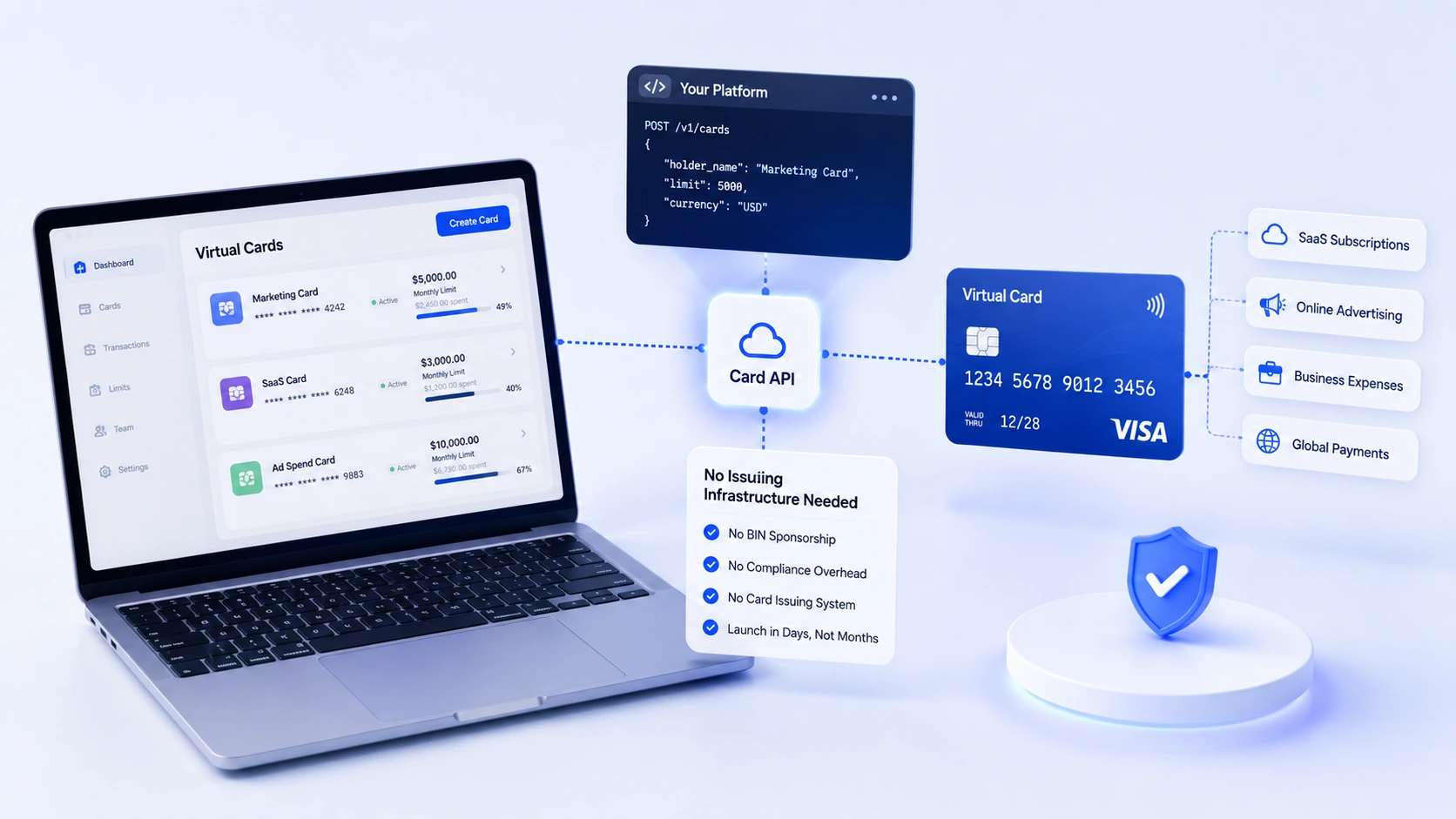
The issuing partner’s APIs connect virtual card functionality with the startup’s existing application. A simplified architecture looks like this:
Fintech Application → Issuing API → Card Infrastructure → Card Network → Merchant
Depending on the provider, APIs may support functions such as card creation, card management, status updates, spending controls, and transaction data.
For example, a customer could request a virtual card inside the fintech application’s interface. The application sends the request through the issuing API, receives the relevant card response, and presents the card through the startup’s own product experience.
The infrastructure can therefore remain behind the scenes. Customers continue interacting with the fintech application’s interface rather than a separate provider platform.
4. Configure Card Controls and User Rules
Virtual cards become more useful when startups can define how they should be used.
Depending on the infrastructure, startups may be able to configure spending limits, transaction restrictions, user permissions, and card status controls.
A business-focused fintech, for example, could assign different spending limits to employees or departments. A platform supporting subscription payments could use transaction rules to help customers manage recurring charges.
This makes the virtual card part of a broader financial workflow rather than an isolated payment feature.
5. Test and Launch the Program
Before making virtual cards available to a larger customer base, test the complete experience from card creation to transaction reporting.
Testing should cover both normal and exception scenarios, including successful payments, declined transactions, spending limits, refunds, card status changes, and transaction visibility.
The startup should also verify that transaction data is correctly reflected in its own application and that users receive clear information when payments are approved, declined, or refunded.
A limited rollout can then help the team identify technical or operational issues before expanding the program.
What Fintech Startups Should Look for in an Issuing Partner
An issuing partner becomes part of the product’s infrastructure, so the decision should go beyond whether the provider can issue virtual cards.
API and Integration Capabilities
The APIs should support the functions required by the product and provide enough flexibility for future development. Documentation, available endpoints, authentication, transaction data, and integration requirements should all be evaluated before implementation.
Compliance and Risk Support
Startups should clearly understand which regulatory, verification, monitoring, and operational responsibilities are handled by the provider and which remain with the fintech company.
This is particularly important when a startup plans to operate across multiple markets or serve different customer segments.
Card Controls
Spending limits, transaction restrictions, card status management, and user permissions can be important when virtual cards form part of a broader expense or financial management product.
Geographic Coverage
The provider’s supported countries, currencies, and card programs should match both the startup’s current market and its expansion plans.
Scalability
Infrastructure that works for an MVP should also have a path toward higher card and transaction volumes.
Before committing to a provider, consider how the infrastructure will handle growth in users, cards, transactions, and additional programs.
Multi-BIN and Multi-Program Support
Fintech companies planning multiple products, customer segments, or markets may eventually require multiple card programs or BIN configurations.
Having this flexibility available can make it easier to expand without replacing the underlying infrastructure.
Pricing and Fees
Evaluate the complete cost structure rather than focusing only on card issuance fees.
Depending on the program, costs may also include transactions, funding, foreign exchange, platform services, or other operational components. Understanding these costs early can help startups build a more realistic financial model.
What to Consider Before Launching Virtual Cards
Adding virtual cards should be treated as both a product decision and an infrastructure decision.
Compliance: Confirm the responsibilities associated with the target markets, customer types, and intended card use cases.
Security: Make sure sensitive card and transaction data is handled through appropriate security measures and access controls.
Testing: Test successful transactions as well as declines, refunds, spending limits, and other edge cases.
Cost: Model infrastructure and transaction-related costs against the expected revenue or business value of the card program.
Scalability: Consider future users, transaction volume, additional markets, and new card programs before selecting the infrastructure architecture.
Addressing these areas before launch can reduce the risk of technical or operational changes as the product grows.
How BUVEI Supports Fintech Virtual Card Programs
For fintech startups that want to add virtual cards without building the underlying issuing infrastructure themselves, BUVEI provides virtual card issuing infrastructure that can be integrated into business applications.
Its white-label capabilities allow businesses to incorporate virtual card programs into their own customer-facing products while maintaining their own branding and user experience. API-based integration can connect card functionality with existing fintech applications and workflows.
For growing programs, capabilities such as card controls, transaction management, and multi-BIN support can help businesses manage different card requirements as their programs expand.
This infrastructure-focused approach allows fintech teams to dedicate more resources to product development, customer experience, and growth while relying on established infrastructure for core card issuing capabilities.
Frequently Asked Questions
Can fintech startups issue virtual cards without building their own infrastructure?
Yes. A fintech startup can work with an issuing infrastructure provider that supplies the underlying card capabilities and connect those functions to its own product through APIs.
What infrastructure is needed to offer virtual cards?
A virtual card program can involve card issuing, payment network connectivity, APIs, card management, transaction processing, spending controls, compliance, funding, settlement, and reporting.
How do fintech startups integrate virtual cards into their products?
Startups typically use APIs provided by an issuing infrastructure partner. These APIs can connect functions such as card creation, card management, spending controls, and transaction data with the startup’s existing application.
Can fintech startups customize virtual cards through an issuing partner?
In many cases, yes. The available level of customization depends on the issuing infrastructure, but startups may be able to control branding, user workflows, spending rules, card settings, and other parts of the customer experience.
How does white-label virtual card issuing work for fintech startups?
A white-label model allows a fintech startup to incorporate virtual card capabilities into its own product while relying on an external provider for underlying issuing infrastructure. The startup can focus on its customer-facing experience while the infrastructure partner supports the card program.
Conclusion
Fintech startups do not need to build every layer of card issuing infrastructure themselves to offer virtual cards. By defining the use case, selecting an appropriate issuing partner, integrating the required APIs, configuring card controls, and testing the complete payment experience, startups can add virtual card functionality without taking on the full burden of an in-house infrastructure build.
The right approach depends on the startup’s product requirements, target markets, technical resources, and growth plans. For many fintech teams, accessing established issuing infrastructure can provide a practical path from an initial virtual card concept to a scalable product.