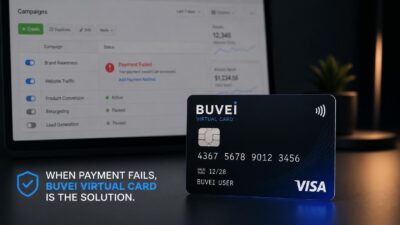
If you run Facebook Ads, Google Ads, or TikTok Ads, you’ve probably seen this before — payments look fine, but still fail.
In 2026, this is happening more often as ad platforms tighten risk controls and cross-border checks.
That’s why more media buying teams are moving to multi-BIN virtual cards with USDT top-up to keep payments stable while scaling.
BUVEI is built for this exact workflow.
It lets teams issue cards instantly, fund them with USDT, and switch between US / HK / UK BINs depending on campaign needs.
At scale, the real issue is no longer performance.
It is payment stability and continuity.
Why Facebook Ads Payments Keep Failing
Facebook (Meta) uses a strict and dynamic payment risk system that evaluates both the card itself and account-level behavior.
Most failures come from multiple factors rather than a single cause.
Common issues include BIN mismatch, where the card’s issuing region does not align with the campaign or account profile, and card reuse across multiple Business Managers, which increases account association risk.
Cross-border transaction spikes, rapid budget increases, or repeated payment retries can also trigger automated fraud checks.
As campaigns scale, these issues often compound.
What starts as occasional declines can gradually turn into broader payment instability across multiple accounts.
This is why experienced media buyers treat payment infrastructure as part of scaling strategy, not just a technical detail.
Why BUVEI Is Used for Facebook Ads Operations
BUVEI is designed for environments where payment reliability is more important than payment simplicity.
Instead of relying on traditional bank cards that may freeze, decline, or trigger regional restrictions, BUVEI gives teams more control over how payment identities are structured.
It combines several operational advantages:
- Multi-BIN support (US / HK / UK / SG / EU)
Allows teams to match payment geography with campaign targeting. - USDT (TRC20 / BSC) funding
Enables fast global top-ups without traditional banking delays. - 1-second card issuance
Critical for replacing failed or flagged cards instantly during active campaigns. - API automation
Used by larger teams to manage bulk card creation, budgeting, and lifecycle control. - Cashback (1–2%)
Helps reduce overall media buying costs at scale.
Individually, these features are useful.
But their real value comes from how they work together in high-volume ad operations.
How BUVEI Works in Real Campaign Environments
In practical use, BUVEI fits into a very simple operational loop.
Teams first fund their BUVEI wallet using USDT. Once the balance is available, they issue a virtual card based on campaign requirements — often choosing US BIN for US traffic or HK BIN for Asian accounts depending on strategy.
The card is then bound directly to Facebook Business Manager and used as a standard USD payment method for ad spend.
From that point on, payment processing behaves like a traditional card system, but with a key difference:
If a card is declined, restricted, or flagged, it can be replaced almost instantly without waiting for bank support or long verification cycles.
This significantly reduces downtime during scaling phases, especially for teams running multiple campaigns simultaneously.
Multi-Account Scaling Strategy
When advertisers move from single-account testing to multi-account scaling, payment structure becomes part of risk management architecture.
Most teams naturally converge on a few operational patterns:
- One card per ad accountto isolate risk exposure
- Avoiding reuse of the same card across multiple Business Managers
- Aligning BIN regions with campaign geography for consistency
At the infrastructure level, payment systems are often combined with:
- Anti-detect browsers to separate device fingerprints
- Residential or proxy IPs to diversify network signals
- Structured account hierarchies for campaign segmentation
The goal is not complexity for its own sake, but predictable separation across accounts and systems.
Cost Optimization at Scale
As ad spend grows, payment-related inefficiencies become more visible and financially significant.
Teams begin to track not only ad performance metrics, but also hidden operational costs such as:
- Card issuance costs
- Top-up friction and delays
- Failed transaction losses
- Capital lock-up in inactive cards
- Cashback or rebate recovery
BUVEI addresses these cost layers through a combination of transparent pricing, crypto-based funding, automated workflows, and cashback incentives ranging from 1–2% depending on volume.
For large-scale advertisers, even small efficiency gains in payment flow can translate into substantial monthly savings, especially when managing dozens or hundreds of active ad accounts.
Step-by-Step: Issue BUVEI Virtual Card with USDT
1. Register BUVEI Account
Create an account via web or mobile app. Complete basic verification and optional KYC depending on usage level.
2. Top-Up with USDT (TRC20 / BSC)
Navigate to the wallet section, select USDT network, and transfer funds from exchanges such as Binance, OKX, or Bybit.
Always confirm the correct network before sending funds, as incorrect transfers may be irreversible.
3. Issue Virtual Card
Select card type (Visa or Mastercard), choose US or HK BIN depending on campaign region, and set spending parameters such as limit and usage type.
Once issued, card details are generated instantly:
- Card number
- Expiry date
- CVV
Best practice remains one card per ad account to maintain clean account separation.
FAQ: Facebook Ads + BUVEI
Is BUVEI virtual card good for Facebook Ads?
Yes. It supports multi-BIN infrastructure, USDT funding, instant issuance, API automation, and cashback, making it suitable for performance marketing operations.
Which BIN is best for Facebook Ads?
US BIN and HK BIN are generally the most stable, depending on target geography and account structure.
Can I use USDT to pay for Facebook Ads with BUVEI?
Yes. You fund BUVEI using USDT (TRC20 or BSC), then use the issued card for USD ad payments on Facebook.
How many cards do I need for multi-account campaigns?
Typically one card per ad account. Larger operations may scale to dozens or hundreds depending on campaign structure.
What if my BUVEI card is banned?
You can instantly freeze and replace the card, allowing campaigns to continue with minimal interruption.
Final Verdict
BUVEI is widely used by affiliate marketers, media buying teams, e-commerce operators, and Web3 projects running paid traffic campaigns in 2026.
Its core value lies in combining payment flexibility, BIN diversification, USDT funding, rapid card replacement, automation, and cost optimization into a single operational system.
For teams focused on scaling paid advertising while minimizing payment failure risk, BUVEI fits naturally into that workflow.