


Introduction
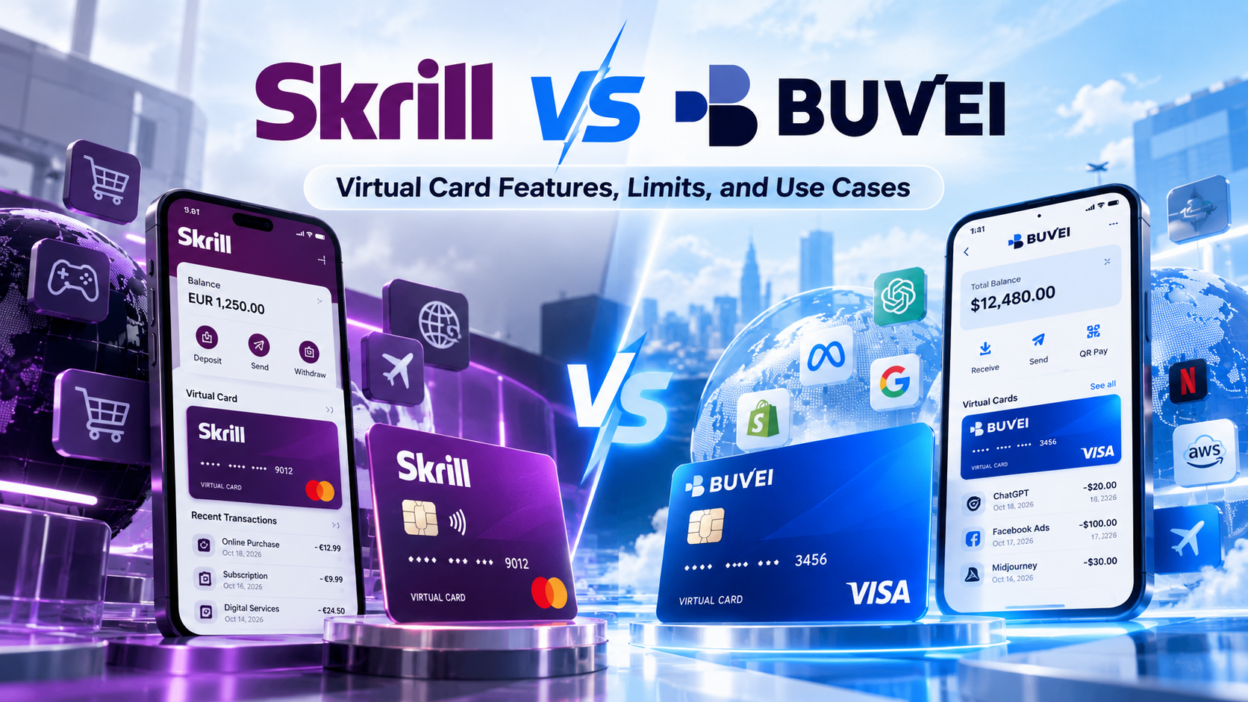
Skrill vs BUVEI is a useful comparison if you're choosing a virtual card for online payments. Skrill links its virtual prepaid Mastercard to its digital wallet, while BUVEI offers virtual Visa and Mastercard cards with multiple BIN options and card management features.
The right choice depends on your location, funding preferences, and how you manage payments. This guide compares both products' features, limits, fees, and practical use cases to help you decide which fits your needs.
Skrill vs BUVEI: Key Differences at a Glance
| Feature | Skrill | BUVEI |
|---|---|---|
| Card network | Virtual Mastercard | Virtual Visa and Mastercard |
| BIN options | Skrill-issued card | Multiple BIN regions |
| Funding | Skrill wallet balance | Supported methods, including USDT |
| Card management | Wallet and card controls | Multiple cards, spending limits, freeze and close controls |
| Transaction tracking | Account transaction history | Card-level transaction records |
| Main use cases | Personal online payments | Subscriptions, advertising, and multi-card expense management |
The key difference is that Skrill connects online spending to its wallet, while BUVEI offers more flexibility for organizing payments across multiple virtual cards.
Skrill vs BUVEI: Virtual Card Features Compared
Card Networks and BIN Options
Skrill's Virtual Prepaid Mastercard lets eligible users pay online at merchants that accept Mastercard. It is distinct from Skrill's physical prepaid card and cannot be used for ATM withdrawals.
BUVEI offers virtual Visa and Mastercard options across multiple BIN regions. This provides more choice when selecting cards for different payment requirements.
A particular BIN does not guarantee payment approval. Merchant policies, billing details, card restrictions, and transaction checks can all affect whether a payment succeeds.
Funding Methods
Skrill's virtual card uses the available balance in a Skrill account, making it convenient for users who already rely on its digital wallet.
BUVEI supports funding through available methods such as USDT on TRC20 and ERC20 networks, subject to account availability. Once funds are credited, users can make eligible payments with their virtual cards.
When comparing costs, consider deposit fees, network charges, currency conversion, and applicable card fees. Neither funding method is automatically cheaper in every situation.
Card Management and Spending Controls
Managing multiple subscriptions or advertising accounts can become complicated when every payment uses the same card.
BUVEI offers features designed to help users organize their expenses:
- Multiple virtual cards: Separate payments by subscription, project, or advertising account.
- Spending limits: Set card-level budgets.
- Freeze and unfreeze: Temporarily suspend or restore card usage.
- Card closure: Close cards that are no longer needed.
- Transaction tracking: Review individual card activity and spending records.
These controls can make it easier to identify expenses and keep different budgets separate. Skrill also provides wallet and card management, along with account transaction history, but BUVEI's multi-card approach is particularly relevant to users managing several payment streams.

Skrill vs BUVEI: Limits, Eligibility, and Fees
Supported Countries and Eligibility
Skrill's Virtual Prepaid Mastercard is available to eligible residents of authorized European Economic Area (EEA) countries and the UK. Having a Skrill account does not automatically qualify you for the card.
BUVEI availability depends on its supported regions and account requirements. Check the current eligibility conditions for either service before relying on a card for an important payment.
Transaction Limits
Skrill publishes the following limits for its Virtual Prepaid Mastercard over a rolling 24-hour period:
| Currency | Published 24-Hour Limit |
|---|---|
| EUR | €6,300 |
| USD | $7,000 |
| GBP | £4,550 |
| PLN | 23,000 PLN |
These are published limits, not guaranteed spending amounts for every account. Available balance and account restrictions may affect actual use.
BUVEI offers configurable card-level spending limits to help users manage budgets. These settings do not override underlying transaction caps or merchant restrictions.
Virtual Card Fees
Skrill's fees vary by product and market, so consult the fee schedule applicable to your account.
BUVEI displays applicable top-up and payment fees within its platform. Users should also account for any relevant network costs and currency conversion charges.
For a fair comparison, look at the total cost of your typical transactions rather than card issuance fees alone.
Skrill vs BUVEI: Which Fits Your Needs?
Online Shopping and SaaS Subscriptions
Skrill can suit users who already hold a wallet balance and need a virtual card for eligible online purchases.
BUVEI offers another approach for recurring payments. Separate virtual cards for services such as ChatGPT, Canva, or Notion can help distinguish subscription expenses and make individual charges easier to review.
Neither card is guaranteed to work with every merchant. Acceptance depends on the merchant's requirements, billing details, and card restrictions.
Advertising Payments
For advertisers and agencies, keeping campaign expenses separate can make budget reviews easier.
BUVEI's features support this workflow through:
- Separate cards for different accounts or projects.
- Spending limits for individual budgets.
- Transaction records for reviewing charges.
Skrill may also work for eligible advertising transactions, depending on the platform's payment requirements. However, BUVEI's multi-card management can be useful when advertising expenses need to be organized across several accounts.
Neither a particular BIN nor multiple cards guarantees approval by an advertising platform.
Team and Business Expenses
Businesses managing software, advertising, and project expenses may need more than a single card and a general transaction history.
BUVEI's multiple-card management, spending controls, and transaction tracking help organize expenses by project or purpose. This can make individual charges easier to review and budgets easier to manage.
Skrill remains an option for eligible users whose primary need is online spending from a digital wallet. The better fit depends on whether you need wallet-based payments or more structured multi-card expense management.
Skrill or BUVEI: Which Should You Choose?
Skrill may suit you if you:
- Already use a Skrill wallet.
- Qualify for its Virtual Prepaid Mastercard.
- Mainly make personal online payments.
BUVEI may suit you if you:
- Need multiple virtual cards for different expenses.
- Want a choice of BIN regions.
- Need card-level spending limits and transaction tracking.
- Prefer supported USDT funding options.
- Manage subscriptions, advertising budgets, or project expenses.
Before deciding, check regional availability, applicable fees, and the restrictions that apply to your account.
Frequently Asked Questions
What Are the Main Differences Between Skrill and BUVEI?
Skrill focuses on wallet-linked virtual card payments, while BUVEI offers multiple virtual Visa and Mastercard options with flexible spending controls and transaction tracking. Skrill is geared toward eligible users making personal online payments, while BUVEI provides additional tools for managing subscriptions, advertising expenses, and payments across different projects.
Does BUVEI Support Multiple Virtual Cards?
Yes. BUVEI supports issuing and managing multiple virtual cards, helping users separate subscription payments, advertising expenses, and other online purchases.
Can I Fund BUVEI with USDT?
BUVEI supports USDT funding through available networks such as TRC20 and ERC20, subject to account availability. Funding a wallet does not guarantee that every merchant will accept the associated card.
Conclusion
Skrill provides a straightforward way for eligible users to make online payments using their Skrill wallet balance. For users who mainly need a wallet-linked virtual card for personal purchases, this may be enough.
BUVEI offers a more flexible virtual card solution, with features designed to help users manage different payment needs, including:
- Virtual Visa and Mastercard cards for eligible online payments.
- Multiple BIN regions to provide more card options for different payment requirements.
- USDT top-ups through supported TRC20 and ERC20 networks.
- Flexible card management, including multiple cards, spending limits, freeze and unfreeze controls, and card closure.
- Transaction tracking and fee visibility to help users review payment activity and manage costs.
For users who simply need a card linked to an existing wallet, Skrill may be a suitable choice. However, if you're managing software subscriptions, advertising accounts, or expenses across multiple projects, BUVEI offers more tools to keep payments separate and spending easier to track.