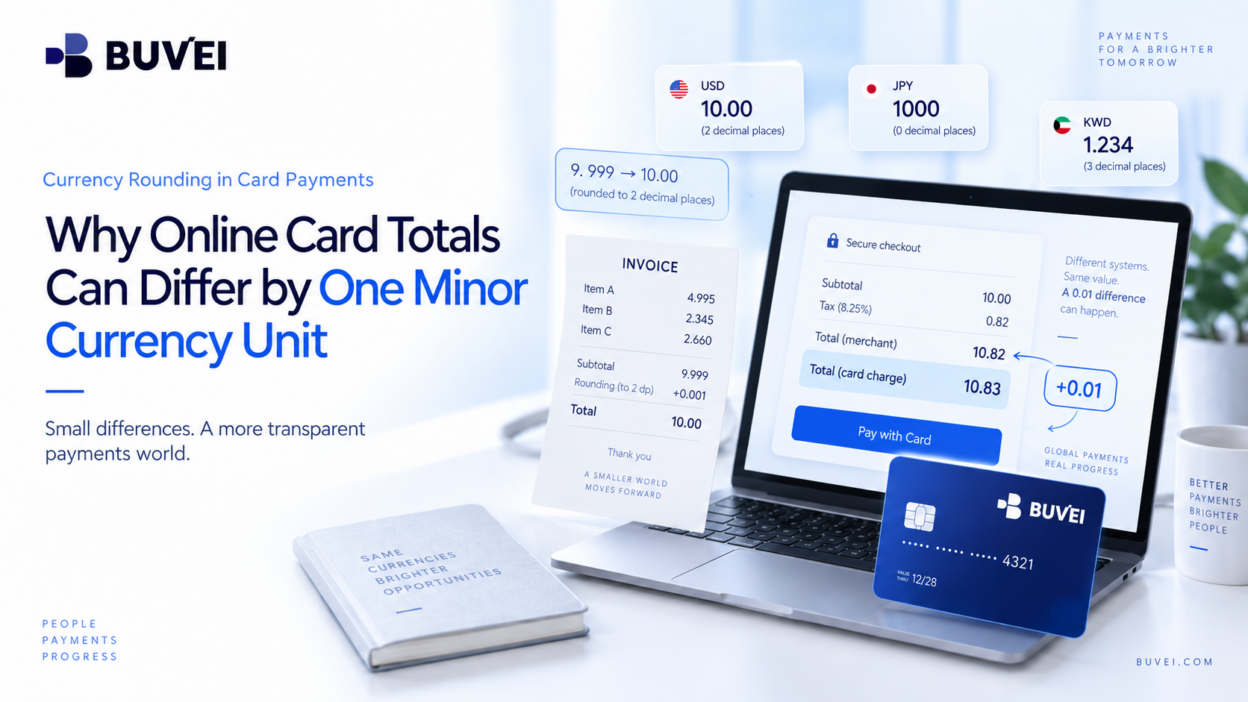
A checkout calculation can be mathematically correct and still differ from a spreadsheet, invoice, or expected total by one cent.
That is because card payments use currency-specific minor units, while merchants may calculate quantities, taxes, discounts, usage fees, refunds, and foreign exchange at different stages of a transaction.
The order in which those calculations are performed determines where rounding happens — and in some cases, two systems can produce slightly different totals even when both calculations are valid.
Small differences are therefore not always a sign that something went wrong. The key is understanding where the amount came from, how it was rounded, and which system produced the final card charge.
What Are Minor Currency Units?
Not every currency uses the same number of decimal places.
Many currencies use two decimal places, while some use none and others use three. This matters because card payments ultimately need to be submitted using the valid precision for the relevant currency.
For example:
- USD commonly uses two decimal places: 10.00
- JPY uses zero decimal places: 1000
- Some currencies use three decimal places: 1.234
The same numeric value can therefore mean different things depending on how an integration represents minor units.
An amount represented internally as 1000 could mean 10.00 in one system, while another system may interpret it as 1000 whole currency units.
This is why payment systems should not assume that every currency behaves like USD or EUR.
[Insert Illustration: Different currencies use different minor units]

Card Networks Need a Valid Final Amount
A merchant may calculate prices internally using more decimal precision than the card payment itself can accept.
For example, a pricing engine might calculate:
24.376
But if the payment currency supports two decimal places, the merchant eventually needs to submit a valid rounded amount such as:
24.38
The important distinction is between the merchant's high-precision internal calculation and the final payable amount submitted to the card network.
This is one reason the number shown in a merchant's internal system, pricing calculator, or spreadsheet may not exactly match the amount that appears on the final card transaction.
Why Can a Card Total Differ by 0.01?
One of the most common reasons is simple:
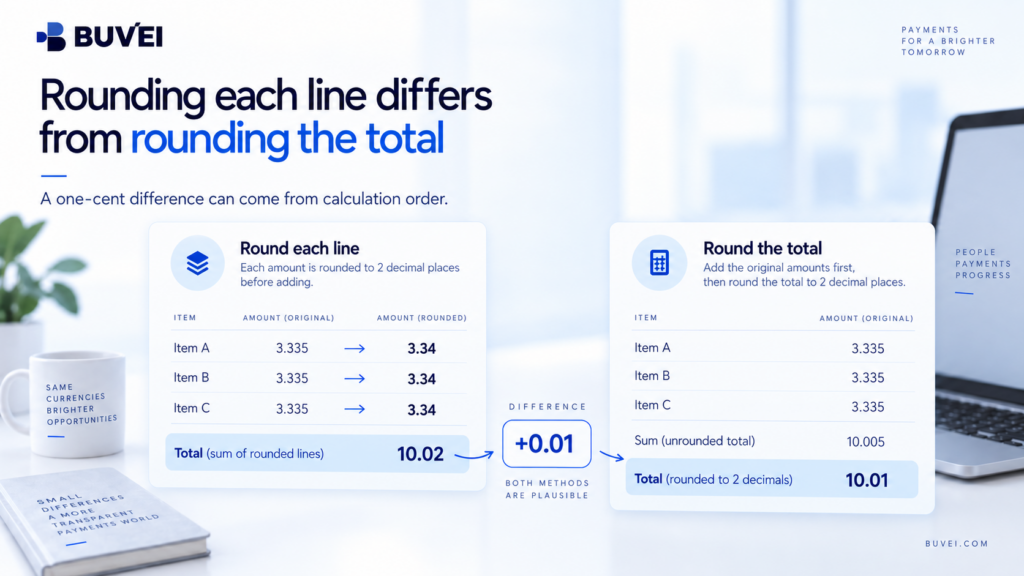
rounding each line is not always the same as rounding the total.
A merchant can:
- Round every item individually and then add the rounded amounts, or
- Add the original high-precision amounts first and round only the final total.
Both methods can produce a valid result, but the final amount may differ by one minor currency unit.
Example
Imagine three items are each priced at:
3.335
If the merchant rounds every line first:
- 3.335 → 3.34
- 3.335 → 3.34
- 3.335 → 3.34
The total becomes:
3.34 + 3.34 + 3.34 = 10.02
If the merchant adds the original values first:
3.335 + 3.335 + 3.335 = 10.005
Then rounds the final total:
10.005 → 10.01
The difference is only 0.01, but both results come from a legitimate calculation sequence.
[Insert Illustration: Rounding each line vs. rounding the total]
When reviewing a card charge, it is therefore better to follow the merchant's invoice method instead of assuming that one calculation order must always be used.
Tax Can Introduce Another Rounding Point
Taxes such as VAT may also be calculated at different stages.
Depending on the merchant system and applicable rules, tax may be calculated:
- separately for each item,
- by tax-rate category, or
- on the final invoice total.
Two products with the same tax rate can therefore create a one-cent difference depending on whether the merchant calculates and rounds tax at line level or invoice level.
Because of this, the card amount alone is usually not enough to reconstruct a merchant's tax calculation.
When reviewing a difference, compare the final card charge with the merchant invoice or receipt, including its tax breakdown.
Discounts Can Change the Calculation Base
Discounts create a similar issue.
A merchant may apply a basket discount:
- before tax,
- after tax, or
- proportionally across several items.
The allocated discount on each item may also need to be rounded.
For example, a 10% discount distributed across three products does not always produce exactly the same result as taking 10% off the already-rounded basket total.
This does not necessarily mean the merchant charged incorrectly. It may simply mean that the discount was distributed and rounded at a different stage.
The best way to review the amount is to use the invoice breakdown rather than applying the headline discount percentage to the final total yourself.
Usage-Based Services Can Multiply Small Fractions
Cloud platforms, advertising services, telecom providers, and other usage-based businesses frequently calculate prices using values smaller than one cent.
For example, an individual API request, advertising impression, data unit, or usage event may cost only a fraction of a minor currency unit.
Thousands of these values can then be aggregated before the merchant creates the final bill.
As a result, trying to round every individual usage event manually may produce a different total from the merchant's own billing engine.
When reviewing these transactions, use the merchant's:
- billing period,
- metering method,
- pricing precision, and
- final invoice total.
Foreign Exchange Adds Another Layer of Rounding
Cross-currency payments introduce another possible source of small differences.
A transaction may involve:
- the merchant's original currency,
- an estimated converted amount displayed during checkout,
- network conversion, and
- the final card-account ledger amount.
These values do not necessarily use the same exchange rate or rounding stage.
For example, a merchant may display an estimated conversion for a EUR purchase, while the final ledger amount is calculated later using another processing stage.
That means the estimated converted amount should not automatically be treated as the final card-side amount.
When checking a transaction, compare like with like:
merchant currency → merchant invoice
and
card or ledger currency → final card record

Refunds Can Reveal Earlier Rounding
Partial refunds can also expose rounding differences that were not obvious during the original purchase.
A merchant may need to reallocate:
- taxes,
- discounts,
- item-level amounts, or
- proportional charges
when processing a partial refund.
As a result, the returned amount may not equal a simple percentage of the original card debit.
For example, returning one item from a multi-item order may produce a refund that differs by one cent from the amount originally displayed for that individual line.
The most reliable comparison is therefore between the merchant's credit note or refund breakdown and the amount returned to the card.
Spreadsheets Can Also Create Precision Differences
The merchant is not always the source of the difference.
Spreadsheets and software calculations can contain hidden decimal values even when the displayed number appears rounded.
A cell may display:
10.00
while the stored value is actually:
9.995
Formatting changes what the user sees, but does not necessarily change the underlying number.
Binary floating-point calculations can create similar effects.
For accurate reconciliation, round values explicitly at the same stages used by the merchant instead of relying only on how numbers are displayed in a spreadsheet.
When Is a Small Difference Normal?
A difference of one minor currency unit can be normal when it results from:
- line-level rounding,
- invoice-level rounding,
- tax calculations,
- discount allocation,
- usage aggregation,
- currency conversion, or
- refund allocation.
However, repeated or larger discrepancies should be reviewed.
They may indicate issues such as:
- an incorrect quantity,
- unexpected tax,
- incorrect currency,
- duplicate fees,
- a conversion difference, or
- a merchant calculation that does not match the invoice.
For business expense reconciliation, it can be useful to define an internal tolerance for expected minor-unit differences while reviewing exceptions that exceed that threshold.
The objective is not to ignore small differences, but to make sure they can be explained.
How to Review a Payment Difference
When the amount on a card transaction differs slightly from another record, avoid changing multiple assumptions at once.
Instead, reconstruct the payment in the same order used by the merchant.
A practical review sequence is:
- Confirm the currency and its decimal precision.
- Check the merchant invoice or receipt.
- Identify whether amounts were rounded per line or only at the final total.
- Review tax and discount calculations.
- Check usage-based quantities where applicable.
- Review foreign exchange if more than one currency is involved.
- Compare the merchant total with the final card-side amount.
- Escalate if the difference exceeds expected rounding or changes the actual commercial obligation.
The goal is to record both the unrounded intermediate values and the final payable amount whenever possible.
That makes it easier to identify whether the difference came from calculation order, currency precision, tax, conversion, or another step in the transaction.
How Buvei Helps You Review the Final Card Amount
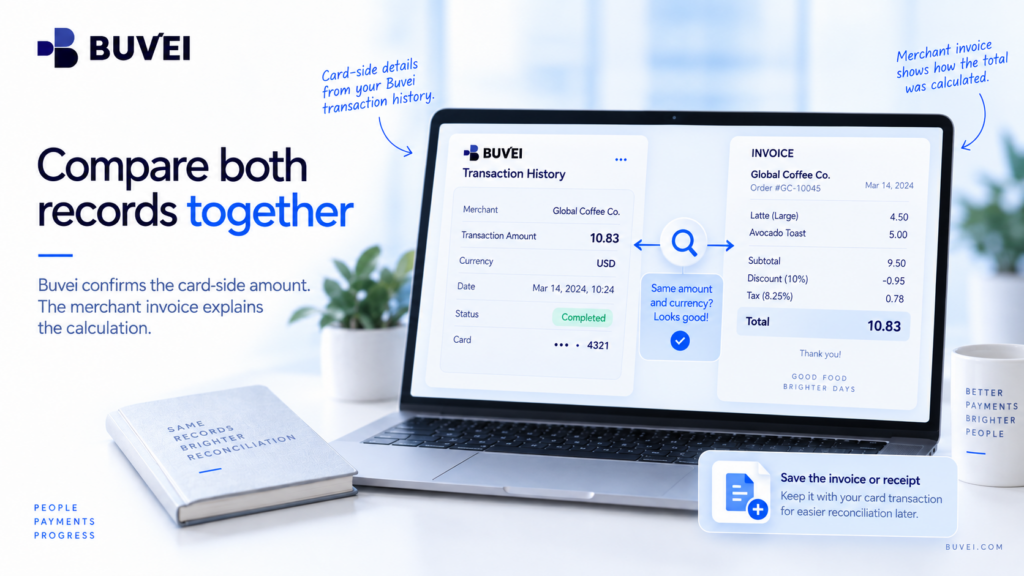
Where supported for the relevant account, Buvei transaction history can help confirm the card-side amount and transaction currency.
However, the card record and the merchant invoice serve different purposes.
The Buvei transaction record shows what was processed on the card side, while the merchant invoice or receipt explains how the merchant calculated the total.
If a payment differs slightly from what you expected, compare both records together instead of relying on only one.
For transactions where precision matters, keeping the merchant invoice or receipt alongside the card transaction can also make future reconciliation easier.
Keep Payment Reviews Secure
When a transaction needs to be reviewed, support teams may ask for information such as:
- your Buvei account or user ID,
- merchant name,
- transaction time,
- amount,
- currency, and
- the last four digits of the card.
Do not send sensitive credentials through ordinary email or chat, including:
- full card numbers,
- card security codes,
- passwords,
- one-time passwords, or
- wallet private keys.
Providing the relevant transaction evidence is usually enough to investigate a payment without exposing unnecessary credentials.
Final Takeaway
A one-cent difference does not automatically mean a card payment is incorrect.
Small differences can appear because merchants, payment systems, spreadsheets, tax engines, FX systems, and card networks may round amounts at different stages.
The most reliable approach is to reconstruct the calculation in the same order as the merchant:
quantity → discount → tax → currency conversion → final rounding
Then compare that result with the final card transaction.
A small difference can be legitimate, but it should still be explainable. If the reconstructed total cannot match the charged amount, or the merchant's calculation appears inconsistent with its own invoice, request a detailed calculation breakdown before retrying the payment.