International travel essentials go beyond booking a flight and a hotel. Having a reliable way to get online when you land can be just as important, especially when you need directions, transportation, hotel information, or a way to stay in touch.
Flights, accommodation, mobile connectivity, and travel payments are often arranged separately, but they all matter before you leave. Taking care of these details in advance can make the first part of an international trip much easier.
Here is what to consider when booking your flight and accommodation, choosing an eSIM, and preparing your travel payments.
Book Your Flight Before Departure
For most international trips, the flight is one of the first major purchases to make. The fare itself is only part of the decision. Baggage, seat selection, cancellation rules, and payment conditions can all affect the final cost.
Compare Flights and Check the Payment Details
Before completing a booking, check the final price and the conditions attached to the ticket. Look at baggage allowances, change and cancellation policies, and any additional fees that appear during checkout.
It is also worth checking the payment page before submitting the transaction. Make sure the billing information is correct and confirm the currency being charged. If you are booking through an online travel agency, check who is processing the payment and how refunds are handled.
These details are easy to overlook when you are focused on getting the flight booked, but sorting them out beforehand can prevent unnecessary payment issues.
Keep Flight Payments Separate
Travel spending can accumulate quickly when flights, hotels, and other bookings are made around the same time. Some travelers prefer to keep these transactions separate from everyday purchases.
A virtual card can be used as a dedicated payment method for eligible online flight bookings. BUVEI offers virtual Visa and Mastercard cards for online payments, including eligible travel-related purchases.
Using a separate card also makes travel transactions easier to identify later when you review your spending.

Reserve Your Hotel or Accommodation
After the flight is booked, accommodation is usually next. The payment terms can vary quite a bit between hotels and booking platforms, so it is worth checking what happens after you click the reservation button.
Check the Hotel's Payment Terms
Some rooms are paid in full at the time of booking. Others allow you to pay at the property, while certain hotels may require a deposit or place a temporary authorization on your card.
Check the cancellation policy and payment schedule before confirming the reservation, particularly if you are booking a prepaid or non-refundable rate.
If you are using a virtual card, also check whether the property requires a physical card for verification or additional charges. That requirement can vary by hotel.
Consider a Dedicated Payment Method
For eligible online reservations, a dedicated virtual card can keep hotel spending separate from everyday purchases.
This can be useful when a trip involves several bookings and expenses. Instead of having airfare, accommodation, and regular spending mixed together, you can use a separate payment method for travel purchases where appropriate.
BUVEI lets users create and manage virtual cards through its platform, providing a way to organize spending for eligible online travel purchases.
Set Up an eSIM Before Your Trip
The flight gets you there and the hotel gives you a place to stay. The next question is what happens when you need to get online after landing.
Why Use an eSIM for International Travel?
The biggest convenience is timing. You can arrange your mobile connection before the trip instead of making a local SIM card your first errand after landing.
That matters when you need directions from the airport, want to order a ride, check a hotel reservation, or send a message as soon as you arrive. There is no need to find a store, compare local SIM options, or swap out a physical SIM card just to get connected.
An eSIM can also make things easier when an itinerary includes more than one destination. Depending on the plan and coverage, you can choose connectivity for a specific country or region without carrying several physical SIM cards.
For international travelers, that means one less thing to figure out at the start of the trip.
Prepare Your eSIM Before You Leave
Choosing your eSIM before departure gives you time to check the destination, data allowance, and validity period without dealing with those details at the airport.
With BUVEI, you can purchase an eSIM directly through the app. Select Travel, open eSIMs, choose your destination and plan, then review the purchase before completing the payment and activation process.
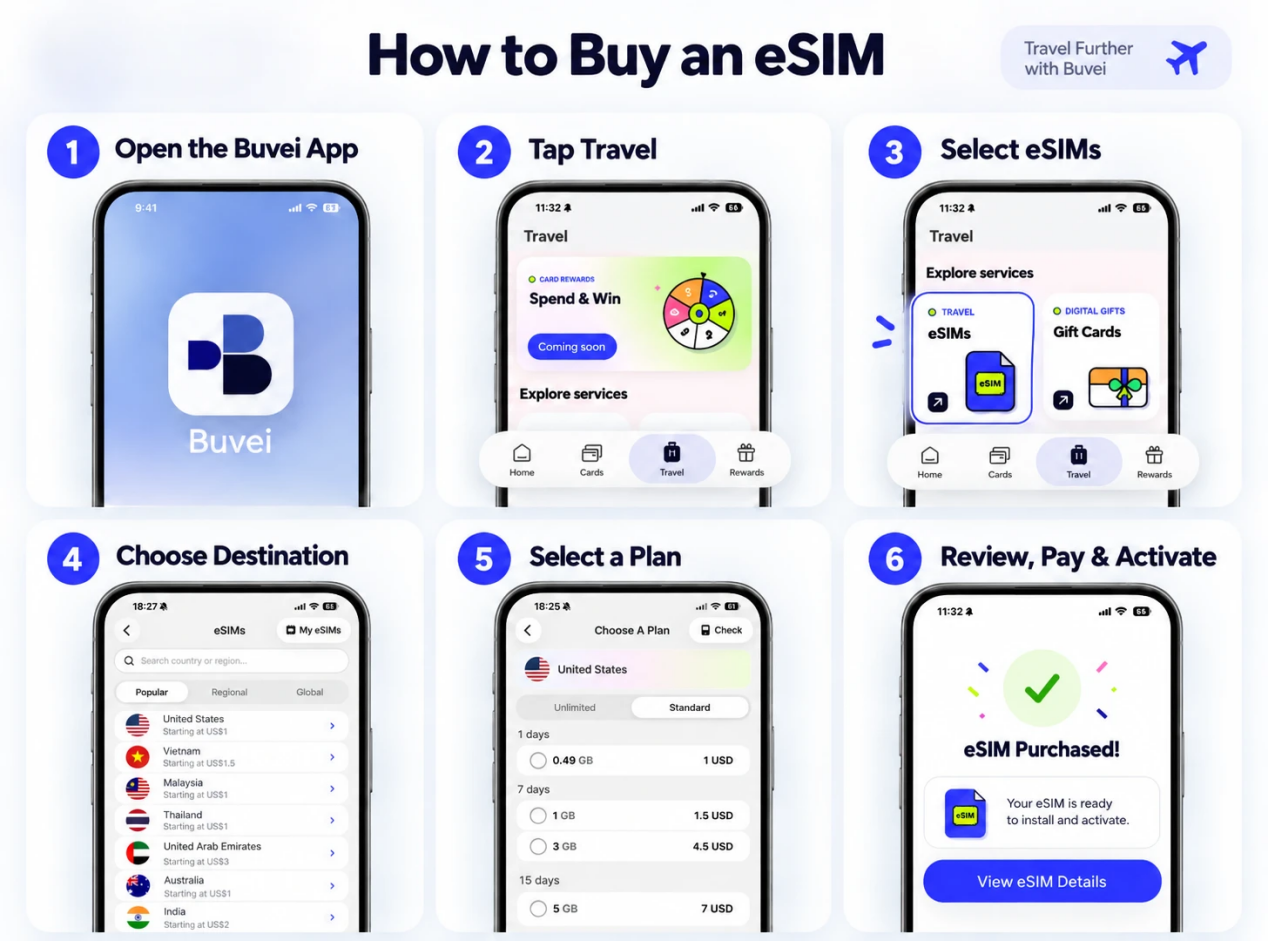
Once your eSIM is ready, keep the installation information accessible and follow the activation instructions when you arrive. Preparing it before departure means you can focus on getting connected instead of looking for a local SIM card after landing.
Choose an eSIM Based on Your Trip
Start with two questions: Where are you going, and how much data will you need?
The answer will depend on the itinerary and how you normally use your phone.
Single-Country Trips
If you are visiting one country, start by checking that the plan covers your destination. Then look at the data allowance and validity period.
A short city trip may require relatively little data if you will spend much of the day on hotel or restaurant Wi-Fi. Someone using navigation constantly, working remotely, or relying on mobile data throughout the day will need more.
A low-priced plan is not necessarily a good fit if the data allowance runs out halfway through the trip.
Multi-Country Trips
Multi-country travel makes coverage especially important.
Before purchasing a plan, check whether all of the countries on your itinerary are included. A regional plan may be more convenient than arranging separate connectivity for each destination, as long as the coverage matches your route.
This is particularly useful for trips where you cross borders frequently. You can keep the same connectivity setup while moving between destinations instead of changing SIM arrangements each time.
Consider How Much Data You Need
Your phone habits are usually a better guide than the number of days on your itinerary.
Maps and navigation, messaging, social media, video, cloud services, and mobile hotspots can all increase data usage. Someone who mainly checks directions and messages may use far less than a traveler who streams video or works from a laptop.
Think about what you actually do on your phone during a typical day and how much Wi-Fi you expect to have. That will give you a more realistic idea of the data allowance you need.

Manage Your eSIM Data While Traveling
Buying an eSIM takes care of the initial connection. Once the trip gets underway, the focus shifts to keeping that connection available.
Track Your Data Usage
Data usage can change from one day to the next. A day spent navigating around a new city, using ride-hailing apps, and uploading photos may consume considerably more data than a quiet day at the hotel.
Checking your usage gives you a clearer picture of how much data is left before it becomes a problem.
BUVEI supports near-real-time eSIM usage information, including data used, data remaining, plan status, and expiration information.
Avoid Running Out of Data
Running out of data is especially inconvenient when you are away from a familiar network. An alert can give you some warning before that happens.
BUVEI supports eSIM usage alerts that can be triggered when data consumption reaches a set threshold, such as 50% or 90% of the plan allowance. This gives users time to decide whether additional data is needed.
It is also worth keeping an eye on the plan's expiration date. An eSIM may stop working because the plan has expired or because its available data has been fully used.
Recharge When You Need More Data
If you use more data than expected, you may not need to start over with a new eSIM.
BUVEI supports recharging an existing eSIM plan. Additional data is added to the remaining balance, while the recharge keeps the current plan rather than switching to another one.
For longer trips, this gives travelers a way to add data when needed without setting up an entirely new connection.
Keep Your Travel Essentials Organized
By the time you leave home, you may have already paid for your flight, reserved your accommodation, and arranged mobile connectivity.
Keeping those pieces organized can make travel spending easier to follow. A virtual card can be used for eligible online travel purchases, while an eSIM provides mobile connectivity after you arrive.
BUVEI brings virtual card services and eSIM services together on the same platform, giving travelers tools for two practical parts of international travel preparation.
International Travel Checklist
Before Departure
- Confirm your flight and review the booking terms.
- Confirm your accommodation and its payment policy.
- Choose an eSIM based on your destinations, data needs, and trip length.
- Prepare the eSIM before leaving.
- Make sure your payment method is ready for eligible online purchases.
During the Trip
- Check your eSIM data usage from time to time.
- Keep an eye on the plan’s expiration date.
- Recharge if you need additional data.
- Keep important flight, hotel, and transportation details accessible.
Conclusion
A well-prepared international trip involves more than booking a flight and finding a hotel. Having mobile connectivity ready before you land can be just as useful, especially when you rely on your phone for directions, transportation, reservations, and communication.
Flights, accommodation, mobile connectivity, and travel payments each solve a different part of the trip. Preparing them ahead of time leaves fewer details to sort out after arrival. With BUVEI, travelers can access eSIM services for mobile connectivity and virtual cards for eligible online travel payments, bringing two practical parts of travel preparation together on one platform.