
In a landscape where digital ads span dozens of platforms and multiple clients, marketing agencies struggle with complexity: keeping ad spend separate, avoiding billing mix-ups, and ensuring financial security. Virtual cards have emerged as a powerful tool to address exactly these pain points. In this article, we explore how agencies use virtual cards to manage dozens of client ad accounts, and show how Buvei, a next-generation virtual card platform, fits into that workflow. We also offer four strategic points to boost your reliability and control when scaling with virtual cards.

Why Agencies Adopt Virtual Cards for Client Ad Accounts
1.1 Clear separation of client spending
One of the most fundamental challenges in agency finance is separating client budgets. With virtual cards, agencies can issue a dedicated card (or card number) per client, campaign, or even per ad platform (e.g. Google Ads, Facebook, TikTok). This ensures each spend is isolated and directly traceable.
When a client terminates or a campaign winds down, that virtual card can be immediately disabled—no need to scramble to reconcile shared accounts or reissue physical cards.
1.2 Tight spending controls and fraud mitigation
Virtual cards allow granular limits: set maximum amounts, valid date ranges, and restrict merchant categories (MCC codes). This cuts down on overspending and rogue charges.
Because many virtual cards are single-use or short-lived, even if credentials leak, the damage is contained.
1.3 Automation, real-time tracking, and reconciliation
Every virtual card transaction is recorded with identifiers (client ID, campaign tag, cost center). This enables real-time dashboards and automated reconciliation.
Some platforms even integrate with accounting or ERP systems to automatically feed expense data.
1.4 Scalability and operational efficiency
Instead of juggling physical cards or relying on employees to expense ad spend, agencies can dynamically spin up and retire virtual cards as needed. This reduces administrative overhead and scales cleanly with client growth.
How to Structure Virtual Card Usage: Four Key Strategies
To maximize the benefits—especially reliability—agencies should adopt strategic structures when issuing virtual cards. Here are four essential strategies:
Strategy 1: One card per client × per platform
Issue a separate virtual card for each client’s ad spend on each ad platform (e.g. Google, Meta, LinkedIn). That way, platform-specific billing, chargebacks, or audits don’t interfere across clients. It also simplifies attribution and reporting.
Strategy 2: Use single-use cards for new or high-risk vendors
When working with new publishers, affiliate networks, or one-off ad buys, generate a single-use virtual card. That card expires immediately after use, minimizing exposure if the vendor is compromised.
Strategy 3: Set nested controls & sub-limits
Within each client or campaign card, set tiered controls: daily caps, geographic restrictions, MCC restrictions. Also, allow subordinate team members limited card issuance under stricter thresholds, so no single mistake devastates your budget.
Strategy 4: Automate billing & client invoicing using metadata
Embed metadata (client ID, campaign code, ad account) in each card issuance and transaction. Use APIs to pull transaction data daily and auto-generate client invoices or internal cost reports. This reduces human error and ensures billing consistency.
Implementing these strategies ensures robustness in real-world conditions—especially when handling dozens of client ad accounts simultaneously.
Why Buvei is a Competitive Choice for Agencies
Having discussed best practices, here’s how Buvei stands out for marketing agencies:
-
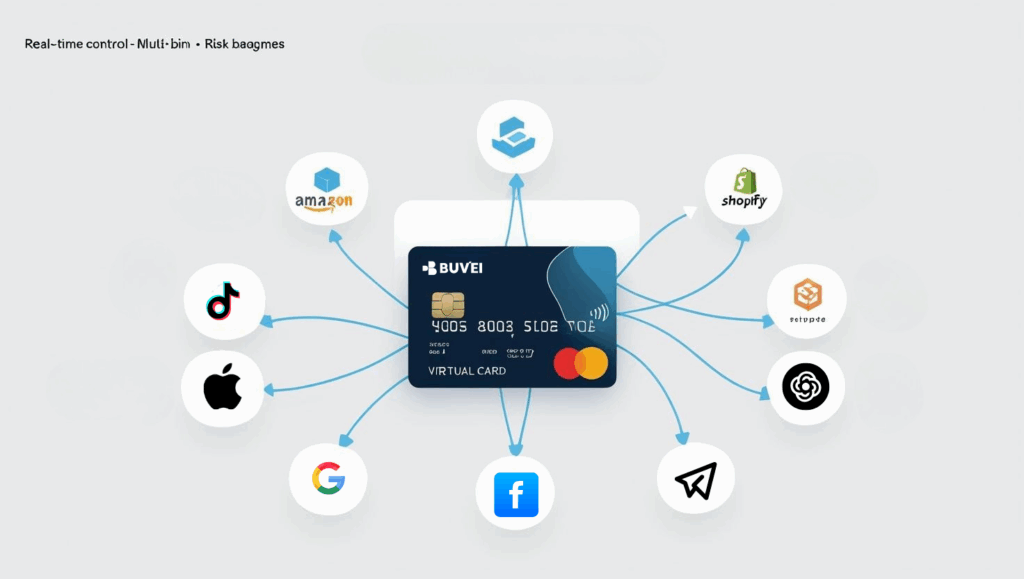
Ad payment focused: Buvei supports payments for major ad networks including Facebook, Google, TikTok, and others, making it well-aligned with agency workflows.
-
Instant issuance: The platform allows virtual credit cards (VCCs) to be generated on demand, enabling rapid onboarding of new clients or campaigns.
-
Multi-scenario support: Beyond ads, Buvei supports subscriptions, international transactions, and even crypto-fiat bridges—giving agencies flexibility across expense types.
-
Security & control: As a virtual card solution with granular controls, Buvei allows agencies to freeze or cancel individual cards without affecting the rest of their payment infrastructure.
-
Modern architecture: Buvei claims support for Web3 payments and aggregated issuance, suggesting it’s built for scalability and cross-border complexity. In short, Buvei is tailor-made for digital marketing operations, offering the controls, flexibility, and speed agencies demand.
Best Practices & Pitfalls to Avoid
Even with the right platform and structure, errors or oversight can erode reliability. Here are best practices and pitfalls to guard against:
Best Practices
-
Audit logs & alerts: Always maintain a full audit trail for card issuance, activation, and spending. Set alerts for unusual behavior (e.g. sudden spikes).
-
Regular reconciliation cadence: Reconcile virtual card charges with ad platform billing daily or weekly, not monthly.
-
Roles & permissions: Ensure only authorized finance or project leads can issue or cancel cards; separate issuance from approval.
-
Backup funds & fallback plan: Maintain a reserve funding method (bank or parent card) in case a card fails or an ad network rejects it.
-
Client transparency & labeling: Label cards and invoices clearly so that clients see exactly how their ad money was used—this fosters trust.

Pitfalls to Avoid
-
Oversight of carryover funds: Unused balance on a client card might accumulate; ensure you reconcile and close cards.
-
Ignoring exchange or cross-border fees: For global ad accounts, be mindful of FX and cross-border fees embedded in virtual card platforms.
-
Overlapping cards: If multiple cards target the same platform without coordination, billing may get merged or flagged by the ad network.
-
Poor vendor onboarding: Using the same card across multiple vendors can make it hard to block misbehaving vendors without affecting others.
-
Lack of fallback: If a card fails mid-campaign and there is no backup method, the campaign could pause and degrade performance.
By adopting the above practices while avoiding the pitfalls, agencies can scale virtual card usage in a secure, reliable way.
Conclusion
Virtual cards are transforming how agencies manage client ad accounts, offering clearer expense separation, tighter security, automated reconciliation, and scalable operations. But success isn’t just about adopting the technology—it’s about structuring card issuance with forethought and applying rigorous best practices.
As a dedicated solution built for digital marketers, Buvei offers a platform designed to support these workflows—giving agencies the speed, control, and reliability they need. If you're scaling ad operations across dozens of clients, adopting virtual cards with the strategies above and a capable partner like Buvei may be the difference between chaos and mastery.
New user benefits, register now to enjoy 40% discount, and coupons will be automatically sent after registration
New user benefits, register now to enjoy 40% discount, and coupons will be automatically sent after registration