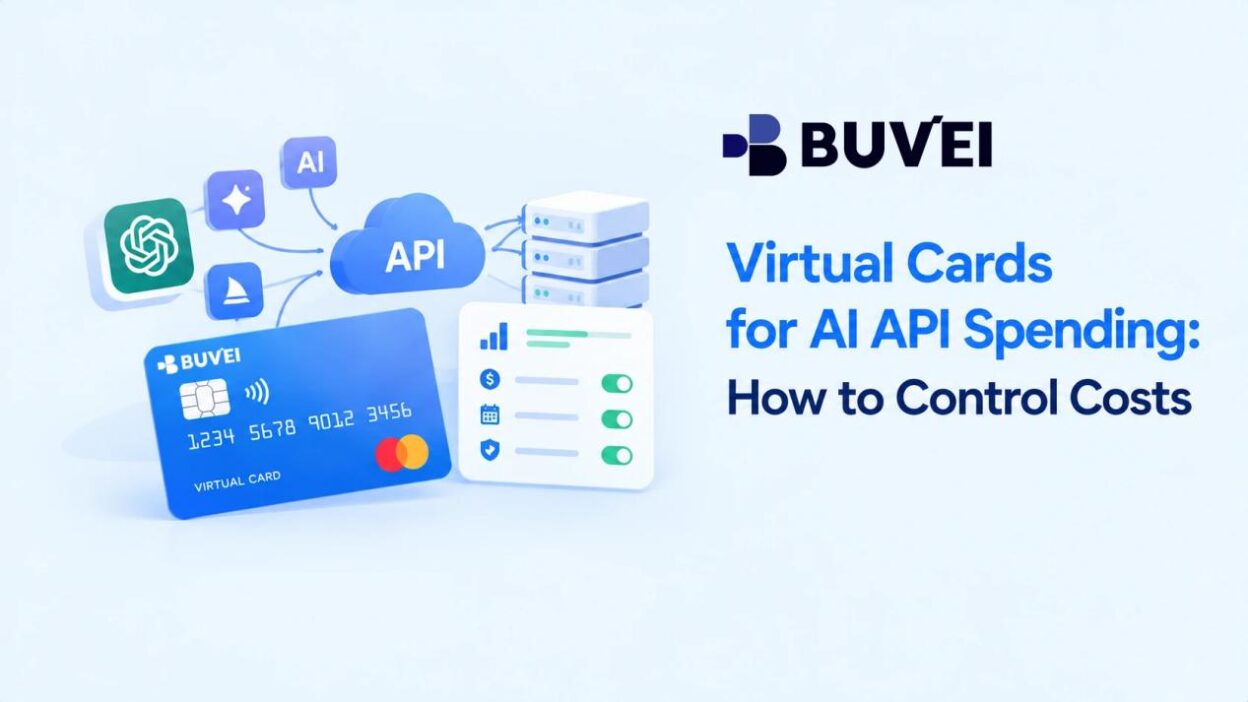
AI API spending can be difficult to predict. A development team may spend relatively little while testing an API, then see costs increase as an application moves into production, traffic grows, or developers begin using more expensive models.
That makes payment management more important than it first appears. Virtual cards can help businesses separate AI-related expenses, set payment-side spending boundaries, and keep transactions easier to track.
They do not replace an AI provider’s usage controls or change API pricing. Instead, virtual cards add another layer of control around how AI API expenses are paid and managed.
Why AI API Spending Can Be Difficult to Control
AI APIs are not always billed like traditional software subscriptions. Instead of paying the same amount every month, businesses may pay according to usage, with costs affected by requests, tokens, model selection, or other billable resources. That creates two practical challenges.
AI API Costs Can Change Quickly
An API that costs very little during development can become a much larger expense once it supports a live application. For example, a team might initially use an AI model for internal testing. After launch, the same application could process significantly more requests. Switching to a more capable model or handling larger workloads can also change the monthly bill.
The challenge is not necessarily the price of the API itself. It is that spending can move faster than a company’s normal software expense cycle.
Multiple AI Services Make Expenses Harder to Organize
Companies rarely use just one AI service forever.
A product team may use one provider for text generation, another for image generation, and additional services for speech, embeddings, or other AI workloads. Developers may also test new services before deciding which ones belong in production. When all of these charges go through the same corporate card, the resulting transaction history can become difficult to interpret.
Finance teams may know how much the company spent overall, but have a harder time answering a more useful question: How much did we actually spend on each AI project or service?
That is where a more structured payment setup can help.
Why Virtual Cards Fit AI API Spending
Virtual cards are useful for AI API payments because they can create a clear separation between AI expenses and general business spending. The value is less about replacing a traditional corporate card and more about giving variable expenses their own payment structure.
Separate AI Expenses From General Spending
A company can dedicate a virtual card to a particular AI provider, project, or type of workload. For example, production API usage could have its own card while experimental AI services are handled separately. The resulting transaction records are easier to review because AI-related charges are no longer mixed with travel, advertising, software subscriptions, and other corporate expenses.
This becomes especially useful when different teams are responsible for different AI projects.
Create a Payment-Side Spending Boundary
A dedicated virtual card can also provide a spending limit around a particular expense. Suppose a team expects to spend around $200 on a particular AI service during a billing period. Instead of putting that expense on an unrestricted company card, the business can assign a dedicated payment method with an appropriate limit. This creates a financial boundary around the payment.
There is an important distinction here: a virtual card spending limit is not an API usage limit. The card does not determine how many requests an application can send or how many tokens an AI model can process. Provider-side controls are still needed to manage API consumption and billing.
The virtual card simply adds another layer of financial control.
Make Transactions Easier to Monitor
A dedicated card can also make AI expenses easier to identify. Instead of searching through a general corporate card statement, finance teams can review transactions associated with a particular AI service or project in one place. That can make unusual charges easier to investigate and simplify internal expense reporting as AI usage expands.
What to Look for in a Virtual Card for AI API Payments
The right virtual card for AI API spending should offer more than a different card number. The most useful capabilities are the ones that make variable expenses easier to control and monitor.
Spending controls are important when API costs fluctuate. Per-card limits can help businesses establish boundaries for individual projects or services without changing the spending structure of the entire company.
Transaction monitoring provides visibility after the payment is made. This is particularly useful when several AI services are being paid through separate cards.
Multiple virtual cards can support different projects, teams, or providers. A business may want one card for production API usage and another for development or experimentation.
Card lifecycle management is useful when a project ends or a payment method is no longer needed. Being able to manage, pause, or close cards helps businesses avoid keeping unnecessary payment credentials active.
Payment compatibility also matters. Whether a virtual card is accepted can depend on the AI provider’s payment requirements, card network, billing location, verification process, and other factors. A particular BIN or region should not be treated as a guarantee of acceptance.
For businesses that need these capabilities, BUVEI supports Visa and Mastercard virtual cards, multiple cards, per-card spending controls, transaction monitoring, and card lifecycle management. BUVEI also provides multi-region BIN options for businesses managing payments across different markets.
How to Manage AI API Spending More Effectively
A virtual card works best when it is used alongside the AI provider’s own billing and usage controls. Think of the setup as two connected layers.
The AI Provider Controls Usage
The AI platform remains responsible for tracking API consumption.
Depending on the provider, businesses may have access to usage dashboards, budgets, alerts, quotas, or spending controls. These tools help teams understand how much API capacity is being consumed and why costs are changing.
For example, OpenAI provides separate API billing and usage information for its API platform, while Google’s Gemini API supports billing and spending controls at relevant account and project levels.
The Virtual Card Controls the Payment Layer
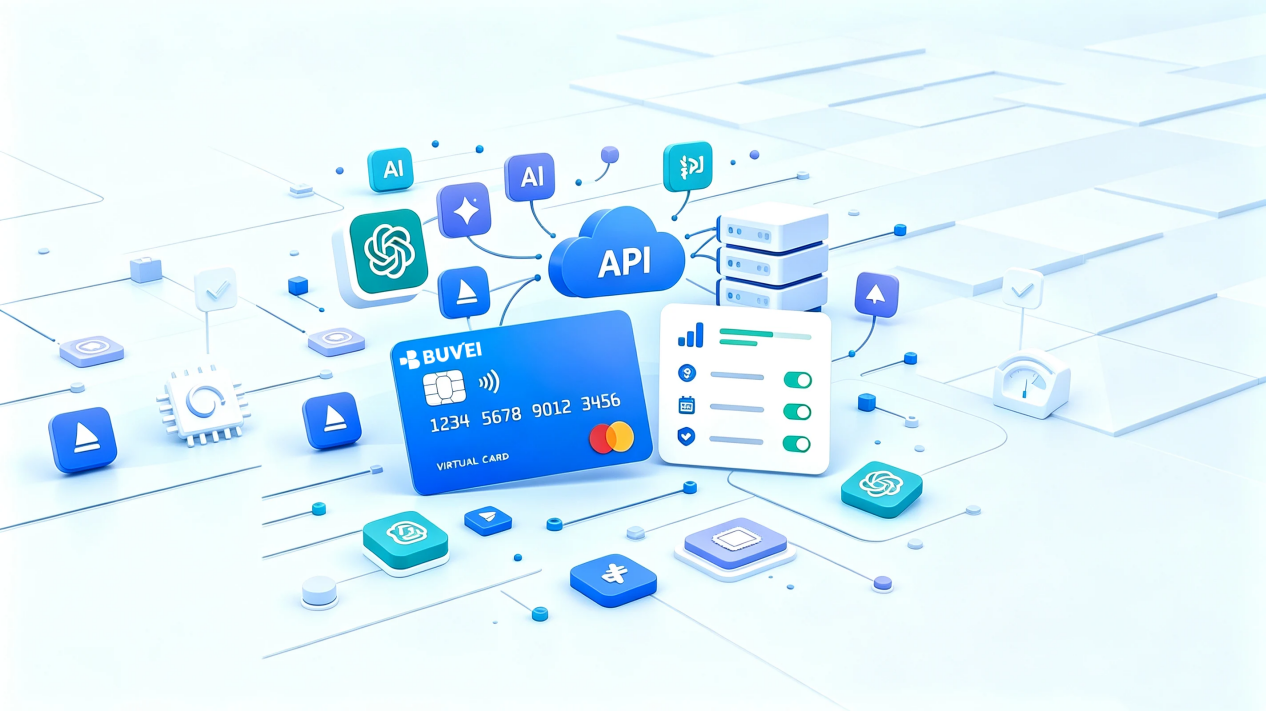
The virtual card sits on the other side of the process. It can help businesses separate AI expenses, establish a spending boundary for a project or service, monitor transactions through a dedicated payment method, and manage different payment credentials for different workloads.
The two layers work together rather than competing with each other.
This becomes particularly useful when development and production spending behave differently. During development, engineers may test multiple models, change prompts frequently, or run large batches, making costs difficult to forecast. Production usage is usually easier to plan around, although costs can still fluctuate with customer traffic and application usage.
Using separate payment structures for these workloads can make both financial reporting and cost reviews more useful.
When Does a Dedicated Virtual Card Make Sense?
A virtual card is not necessary for every AI API expense. If a business uses one AI service occasionally and spending is small and predictable, a regular business card may be sufficient.
The case for a dedicated virtual card becomes stronger when AI spending becomes a meaningful operating expense. It can be particularly useful when several AI providers are being used, multiple teams work with AI APIs, development and production spending need to be separated, or finance needs clearer expense categorization.
The benefit is not simply having another card. It is having a payment method that matches the way the expense is managed internally.
For a growing SaaS company, for example, separating production AI costs from experimentation can make it much easier to understand where the budget is actually going.
Common Challenges With Virtual Cards for AI API Payments
Virtual cards can improve payment control, but they do not eliminate the underlying challenges of AI billing.
Can an AI API Payment Be Declined?
Yes. A virtual card payment can fail because of spending limits, provider payment requirements, billing-country restrictions, verification requirements, card network compatibility, or other merchant-side rules.
Businesses should check the AI provider’s current payment requirements before relying on a particular virtual card for recurring or production billing.
Can AI Spending Still Exceed Expectations?
Yes. A virtual card helps control the payment method, but unexpected API usage can still increase the underlying expense.
Higher traffic, larger workloads, increased token consumption, or changes in model selection can all contribute to higher costs depending on the provider’s pricing model.
That is why card-level controls should be treated as an additional layer rather than a complete AI cost-management solution.
Frequently Asked Questions
Can I Use a Virtual Card for AI API Payments?
In many cases, yes. AI API providers may accept virtual cards, but acceptance depends on the provider’s payment requirements and the specific card. Businesses should verify compatibility before using a virtual card for recurring or production API billing.
Can Virtual Cards Reduce AI API Costs?
Not directly. A virtual card does not change an AI provider’s pricing or reduce the number of tokens or API requests an application uses. What it can do is help businesses establish payment limits, separate expenses, and monitor AI-related transactions more effectively.
Can Virtual Cards Help Control AI API Spending?
Yes, on the payment side. A dedicated virtual card can help businesses create spending boundaries and separate AI expenses from other corporate spending. Provider-side usage and billing controls should still be used to manage actual API consumption.
Can I Use Separate Virtual Cards for Different AI APIs?
Yes. Using different cards for different providers, projects, or teams can make transactions easier to identify and give businesses more flexibility when managing spending limits.
Are Virtual Card Spending Limits the Same as API Usage Limits?
No. An API usage limit controls how much of an API resource can be consumed. A virtual card spending limit controls how much can be charged to that payment method. Using both can provide a more complete approach to managing AI-related expenses.
Conclusion
AI API spending becomes harder to manage as usage grows and more services are added. Virtual cards can give these expenses a separate payment structure, making spending limits and transaction monitoring easier to manage.
They work best alongside provider-side usage and billing controls rather than replacing them. For businesses managing multiple AI services or development projects, a dedicated virtual card can add a practical layer of control to AI API payments.