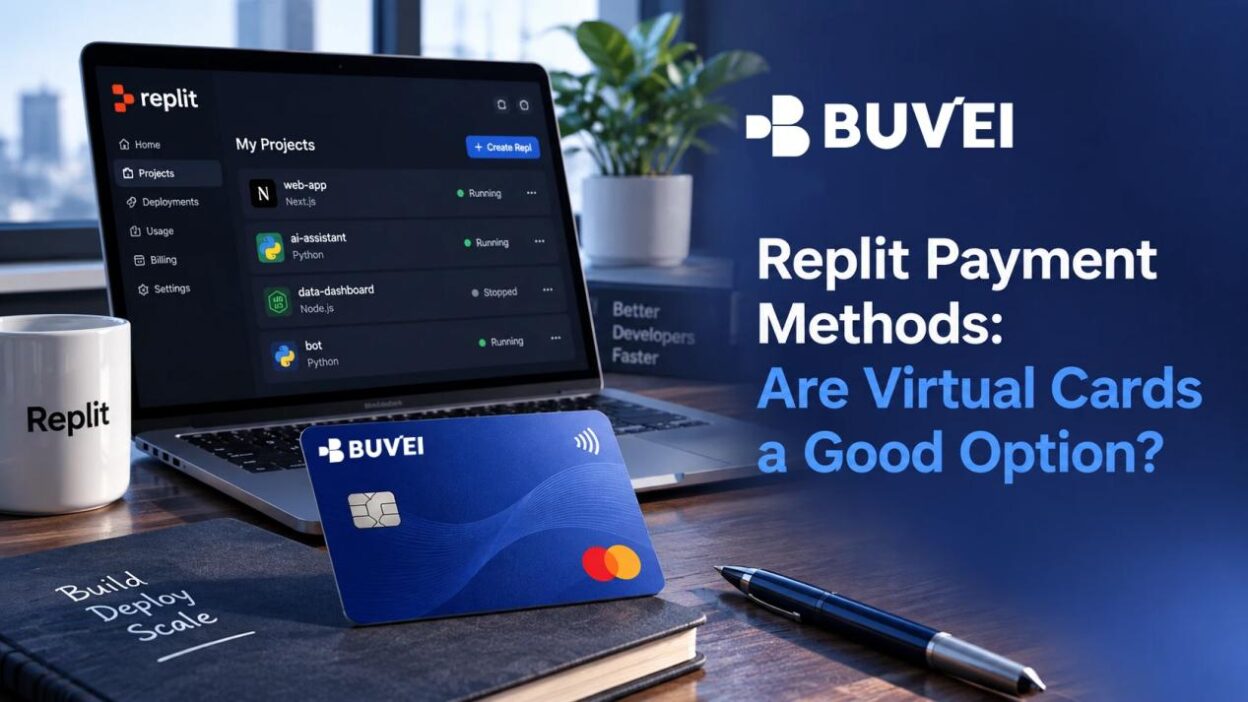
Choosing the right Replit payment methods matters more in 2026 as Replit combines subscriptions, monthly credits, AI features, and usage-based billing. A standard credit or debit card may be enough for occasional users, but developers and businesses managing multiple software expenses may want more control over how Replit charges are separated and monitored.
So which Replit payment method is best: a credit card, debit card, business card, or virtual card?
This guide compares the main Replit payment methods based on convenience, spending control, expense separation, recurring billing, and business use. It also explains when a virtual card for Replit can be a practical option.
What Payment Methods Does Replit Accept?
Replit’s available payment setup can depend on the account, plan, product, and billing arrangement.
For paid accounts, Replit’s current Terms of Service state that subscription fees and usage fees may be automatically billed to the credit card or other payment method associated with the account. Replit also notes that additional usage fees can apply when users exceed the limits associated with their plan.
Replit’s current billing system uses monthly credits across its plans, with usage-based charges applying when included allowances are exceeded. These credits can cover services such as AI features, publishing, and databases, depending on the plan and service being used.
For Enterprise customers, Replit currently supports credit card and ACH bank transfer payments through its self-serve Enterprise checkout.
This means the important question is not simply which Replit payment methods are available. It is which payment method gives you the right balance of convenience, spending control, and expense visibility.
Replit Payment Methods Compared
If you are comparing Replit payment methods, payment acceptance is only one factor. The better option depends on how frequently you use Replit, whether your costs vary, and whether you need to separate development expenses from other spending.
| Payment Method | Best For | Main Strength | Main Consideration |
| Credit Card | Individual users | Simple and familiar | Less expense separation |
| Debit Card | Personal users | Direct access to bank funds | Depends on bank and card settings |
| Virtual Card | Online software spending | Strong expense separation | Acceptance can vary |
| Business Card | Teams and businesses | Easier business expense tracking | May be unnecessary for casual users |
| ACH | Eligible Enterprise users | Suitable for business payments | Not a standard option for everyone |
Credit Card: Best for Simplicity
A credit card is one of the simplest ways to handle Replit payments. It is familiar, easy to manage, and well suited to users who want to keep their billing setup straightforward. For someone using Replit for personal projects or occasional development work, there may be little reason to introduce an additional payment method.
The main limitation is expense separation.
If the same credit card is also used for advertising, travel, SaaS subscriptions, and everyday purchases, Replit charges become part of a larger transaction pool. This can make it harder to identify development expenses when reviewing monthly statements.
Best for: Individual developers who prioritize convenience over detailed expense separation.
Debit Card: Best for Direct Budgeting
A debit card can be useful if you prefer Replit payments to come directly from available bank funds. This approach makes spending relatively easy to understand because charges are linked to the balance in the underlying account rather than a credit line.
The trade-off is that you need to maintain enough available funds for recurring subscription charges and any usage-based expenses. Bank policies, international transaction settings, and issuer restrictions may also affect whether a particular debit card works with an online merchant.
Best for: Personal users who prefer bank-funded payments and have relatively predictable Replit expenses.
Virtual Card: Best for Expense Separation
A virtual card becomes more interesting when comparing Replit payment methods from a spending-management perspective. Instead of using your primary credit or debit card for every online service, you can dedicate a virtual card to Replit or to a broader category such as development software. For example, a freelancer might separate:
- Replit and other development tools
- Advertising expenses
- Business software
- Travel expenses
This can make individual transactions easier to identify and simplify expense reconciliation.
Depending on the provider, virtual cards may also support features such as spending limits, transaction monitoring, or card controls. However, a virtual card should not be viewed as a guaranteed way to improve payment approval. Acceptance can depend on the issuer, card network, region, merchant requirements, and billing configuration.
Best for: Freelancers, developers, and small businesses that prioritize expense separation and online spending control.
Business Card: Best for Teams
A business credit or debit card can make more sense when Replit is part of a broader company expense structure.
If several employees use development and software tools, keeping those purchases on business payment methods can simplify bookkeeping and reduce the need to separate personal and business expenses later.
The limitation is that a standard business card may not provide the same service-level separation as a dedicated virtual card.
Best for: Companies that already use business cards as part of their expense-management workflow.
ACH: Best for Eligible Enterprise Users
For larger organizations, Replit’s payment options can differ from those available to individual users.
Replit’s current self-serve Enterprise offering allows customers to pay with a credit card or ACH bank transfer. Enterprise customers purchase an annual credit commitment, with credits pooled across the organization.
ACH can therefore be useful for companies that prefer bank-based payment processes and already have formal procurement or accounting workflows.
For an individual developer, however, ACH is generally not the most relevant option.
Best for: Eligible Enterprise customers with established business payment processes.
Replit Payment Methods: Which Is Best for You?
The best way to compare Replit payment methods is to evaluate them against the factors that matter most to different types of users.
| Factor | Credit Card | Debit Card | Virtual Card | Business Card | ACH |
| Ease of use | High | High | High | High | Moderate |
| Expense separation | Low | Low | High | High | High |
| Spending control | Moderate | Moderate | High* | High | High |
| Recurring payments | Strong | Strong | Strong* | Strong | Moderate |
| Personal use | Excellent | Excellent | Excellent | Limited | Not typical |
| Business use | Good | Moderate | Excellent | Excellent | Excellent |
| Setup simplicity | Excellent | Excellent | Good | Good | Moderate |
*Features and transaction compatibility depend on the virtual card provider and card configuration.
If Convenience Matters Most
A credit card is usually the simplest option. There is little additional setup, and users can keep their Replit billing together with other online purchases.
If You Prefer Bank-Funded Spending
A debit card may be more suitable. It allows you to pay from available bank funds without relying on a credit line, although you still need to account for recurring and variable charges.
If Expense Separation Matters Most
A virtual card has a stronger advantage. A dedicated card can keep Replit and other development expenses separate from personal purchases or unrelated business spending.
If You Manage a Team
A business card or virtual card can be more useful than a personal payment card. The choice depends on whether the priority is general company accounting or more granular control over specific software expenses.
If You Use Replit Enterprise
Credit card and ACH are the most relevant options because both are supported through Replit’s current self-serve Enterprise payment flow. Overall, there is no single payment method that is best for every Replit user. The right choice depends on your spending pattern and how much control you want over your development expenses.

Are Virtual Cards a Good Option for Replit?
For many developers and small businesses, a virtual card can be a strong Replit payment option when expense separation is more important than simple payment convenience.
This becomes particularly relevant because Replit’s current billing system combines subscription plans with monthly credits and usage-based charges. Replit’s documentation states that AI features use usage-based billing, while publishing and database services can also involve usage-based charges.
As a result, Replit expenses do not always have to look like one fixed monthly transaction.
Why a Virtual Card Can Make Sense
A dedicated virtual card can create a clearer boundary around Replit spending. For example, if a freelancer uses Replit alongside GitHub, AI tools, hosting services, and design software, putting everything on one primary card can make monthly reconciliation more difficult.
A dedicated virtual card can instead be assigned to Replit or to development-related expenses. The main benefits are:
Better expense visibility. Replit-related transactions are easier to identify when they are separated from unrelated purchases.
Greater spending control. Depending on the provider, users may be able to configure card-level spending limits or monitor transactions.
Cleaner business accounting. A dedicated payment method can make software expenses easier to categorize during monthly reconciliation.
Separation from a primary card. Replit payments can be kept apart from everyday purchases and other online services.
These advantages make virtual cards particularly relevant to freelancers and small businesses that manage several recurring digital expenses.
Potential Limitations of Virtual Cards
A virtual card is not automatically better than a traditional credit or debit card.
The first consideration is acceptance. A virtual card still needs to meet Replit’s payment-processing requirements, and compatibility can vary depending on the issuer, network, region, and transaction setup.
The second consideration is available spending capacity. Replit’s usage-based services can cause costs to vary, so users need enough available balance or spending capacity to cover expected charges.
The third consideration is monitoring. A virtual card can make expenses easier to organize, but it does not replace the need to monitor Replit usage.
In fact, Replit itself provides usage limits and budget controls for usage-based billing. Users can set limits to cap additional usage spending. Therefore, the strongest reason to use a virtual card for Replit is not higher payment approval. It is better organization and control over online development spending.
BUVEI for Replit Payments: Who Is It Best For?
If you are specifically looking for a virtual card for Replit, BUVEI can be considered when your priority is separating Replit and other development expenses from your primary payment methods. The strongest use case is not simply paying one Replit subscription. It is building a more organized online spending workflow. For example, a freelancer could dedicate a BUVEI virtual card to development software while using another payment method for advertising or travel. A small business could similarly separate software expenses from general operating purchases.
BUVEI’s current virtual card offering supports virtual Visa and Mastercard cards, per-card spending limits, card controls, and transaction visibility for online spending. These features can be useful when Replit is part of a broader group of recurring software expenses. Instead of mixing Replit charges with unrelated purchases, users can create a clearer transaction trail and monitor software spending more closely.
At the same time, BUVEI should not be presented as a guaranteed Replit payment solution. Actual acceptance depends on Replit’s payment-processing requirements, the card configuration, issuer policies, and other transaction factors. Before relying on a BUVEI virtual card for ongoing Replit billing, users should confirm that the card supports the required transaction type, currency, and spending amount.
In short, BUVEI is most relevant for Replit users who want better expense organization and spending control, rather than users simply looking for the easiest possible payment method.
Frequently Asked Questions
Can You Use a Virtual Card for Replit?
A virtual card may work with Replit if it meets the platform’s payment-processing requirements. However, acceptance can vary by issuer, network, region, and billing configuration.
What Is the Best Payment Method for Replit?
There is no single best option for everyone. Credit cards are generally best for simplicity, while virtual cards are more attractive when expense separation and spending control are important.
Does Replit Use Usage-Based Billing?
Yes. Replit currently uses usage-based billing for services including AI features, while publishing and database services can also generate usage-based charges. Monthly credits cover included usage, with additional charges applying when applicable allowances are exceeded.
Can Replit Charges Exceed the Normal Subscription Amount?
They can, depending on the plan and services being used. Replit’s current terms state that additional usage fees may apply when users exceed the limits associated with their plan. Users can also use Replit’s usage limits and budget controls to manage additional usage-based spending.
Is BUVEI a Good Virtual Card Option for Replit?
BUVEI can be worth considering if your priority is separating Replit and other software expenses from your primary payment methods. Its value is mainly in payment organization, card-level controls, and transaction visibility rather than guaranteed Replit acceptance.
Conclusion
Choosing among Replit payment methods depends on your usage, billing needs, and preferred level of expense control. Credit and debit cards are convenient for personal use, while business cards and ACH can better suit larger organizations. For freelancers, developers, and small businesses, virtual cards offer an additional advantage by separating Replit and other software expenses from everyday spending.
If you want a dedicated way to manage development-related payments, a BUVEI virtual card can be considered as part of your workflow. Just remember that actual payment acceptance depends on the card, issuer, region, and billing configuration.
Sources
Replit. Pricing.
Replit Docs. Billing.
Replit Docs. Replit AI Billing.
Replit Docs. Managing Your Spend.
Replit. Terms of Service.
BUVEI. Global Virtual Cards for Ads & Subscriptions