
TikTok Ads payment failed or declined causes (Read First)
This guide explains why TikTok Ads payment failed or declined, what causes it, and how different card setups and payment structures affect approval success in 2026.
If a TikTok Ads payment fails, the instinct is usually to blame the card. That’s understandable, but in practice it’s often not that simple.
TikTok Ads payment failed is often not about the card itself. In most cases, the failure happens because the platform’s risk system filters the transaction before it even reaches the bank authorization stage.
The timing of the failure actually matters more than the failure itself.
If it happens instantly, before anything feels like a real transaction, it’s usually a hard rejection at issuer or BIN level.
If it worked before and suddenly stops, it often feels more like the system quietly tightening around the account.
And if multiple cards behave differently on the same account, the card is rarely the real variable anymore.
Most advertisers don’t separate these patterns. They just keep switching cards and expect a different outcome.
TikTok Ads payment failed or declined: what’s actually happening
A lot of explanations start with banks, but that’s usually not where things break.
TikTok doesn’t rely purely on bank-side approval in many cases. There is an internal evaluation layer that filters transactions before they become normal card charges.
So what shows up as a “failed payment” is often just a blocked attempt inside the platform’s own risk system.
That system reacts to issuer signals, BIN reputation, and account behavior patterns over time.
This is also why consistency matters more than isolated success.
Why TikTok Ads payment failed even with valid cards
This is where most assumptions start to break.
A valid card doesn’t necessarily mean a compatible card in this environment.
TikTok seems to evaluate not only whether a card works, but whether its issuing profile matches expected behavior patterns.
That’s why two cards with identical limits can behave completely differently.
New cards are especially unpredictable because there is no established behavioral history.
At this stage, repeated failures can also create secondary effects, where future approvals become harder even if nothing obvious changes.
So the issue slowly shifts away from “card validity” toward “system compatibility”.
Why TikTok Ads payment issues appear during scaling
Small budgets often run without noticeable friction.
But once spend increases, the system starts evaluating transactions more frequently and more strictly.
This doesn’t always cause immediate failure. Sometimes it shows up as inconsistency first.
That’s usually where advertisers start rotating cards, trying to stabilize performance manually.
But scaling doesn’t just increase volume — it increases sensitivity.
And that’s where weaker setups begin to show instability.
How to understand TikTok Ads payment failed issues
Before changing anything, it helps to identify the failure layer.
Understanding TikTok Ads payment failed patterns means separating where the rejection actually happens — whether it is blocked at the issuer/BIN level, triggered by account risk signals, or caused by inconsistencies in spending behavior across different payment attempts.
If it fails immediately, it is usually issuer or BIN-level rejection.
If it worked before and suddenly stops, it often reflects account-level re-evaluation.
If different cards behave inconsistently across accounts, then account trust becomes the dominant factor.
Each case requires a different type of adjustment, but most people treat them as the same problem.
TikTok Ads payment failed during scaling campaigns
In practice, advertisers don’t always design payment systems intentionally. They evolve over time.
But you can still see three patterns in real usage.
The single-card model is the most basic. One card, one issuing source. It works until it suddenly doesn’t. When it breaks, everything stops at once.
The multi-card rotation model spreads risk across several cards. It reduces dependency but introduces inconsistency, especially when scaling.
The infrastructure-based model treats payment as a routed system rather than isolated cards. Instead of relying on one issuing source, transactions can be distributed across multiple issuing environments, reducing sensitivity to any single risk profile.
In practice, this is where systems like BUVEI are positioned — not as a “better card”, but as an infrastructure-style setup where multiple BIN environments and routing logic are used to stabilize approval behavior across different accounts and spending conditions.
This distinction becomes more important under TikTok’s risk system, because consistency over time matters more than one-time approval success.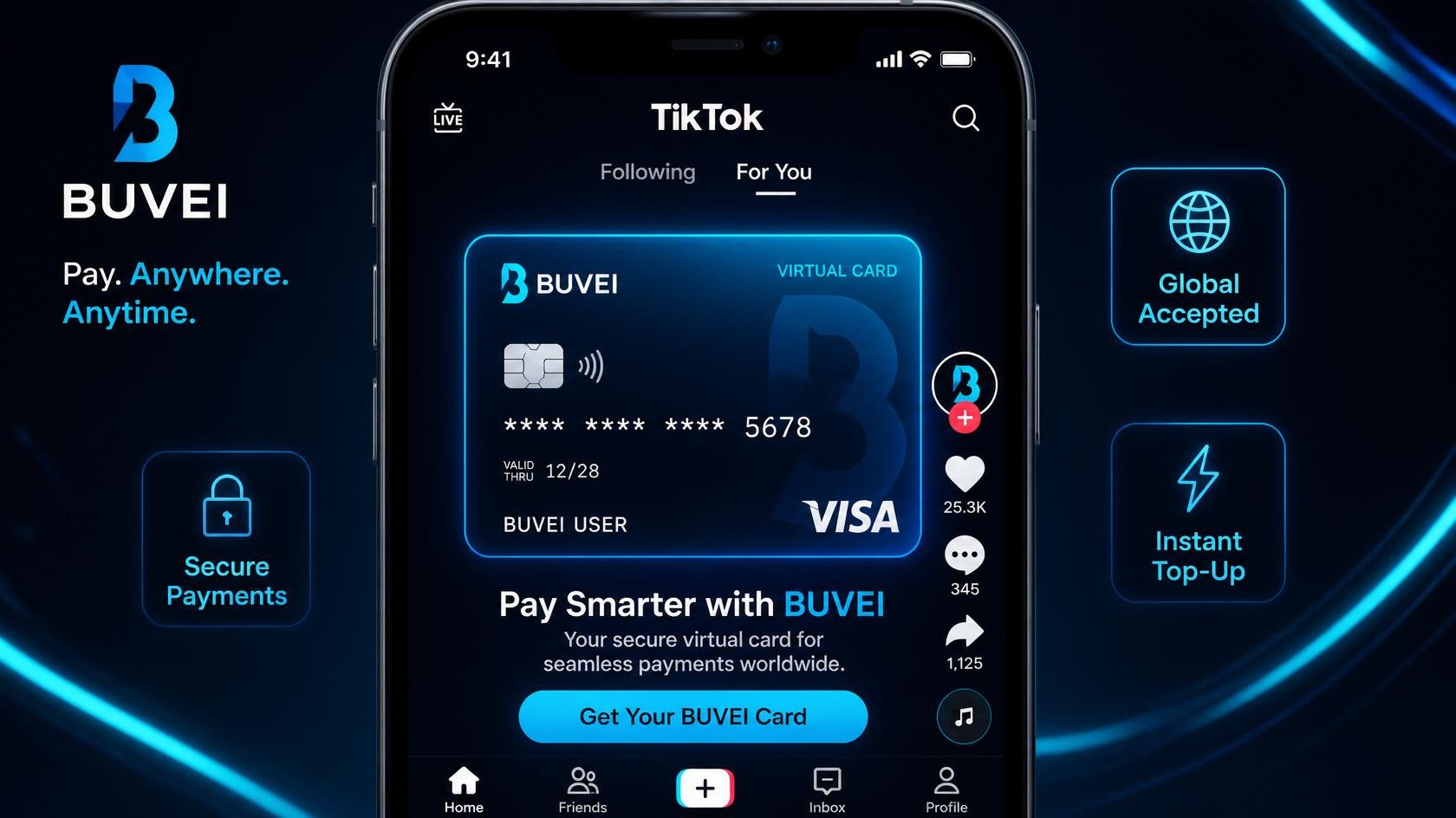
Why some setups feel more stable in real usage
In real-world advertising operations, stability is not just about whether payments succeed once.
It’s about whether approval behavior stays predictable under changing conditions.
Some setups appear fine at first but become unstable as conditions shift slightly.
Others don’t look perfect at any single moment, but behave more consistently over time.
That difference usually comes from structure, not from individual cards.
Infrastructure-based setups — such as BUVEI-style routing systems — tend to reduce dependency on a single issuing profile, which helps smooth out fluctuations in approval behavior when spending patterns change.
Why cards work on other platforms but fail on TikTok Ads
This is a common point of confusion.
A card may work well for SaaS tools, subscriptions, or even other ad platforms, but still behave inconsistently on TikTok Ads.
The reason is not the card itself, but the evaluation environment.
Each platform applies different risk logic. TikTok is generally more sensitive to transaction behavior patterns and issuing consistency.
So compatibility is contextual, not universal.
Final takeaway
Most TikTok Ads payment failed cases are not caused by insufficient balance or “bad cards”, but by how the platform evaluates risk signals across transactions, issuing sources, and account behavior patterns over time.
Once you stop treating this as a simple “card problem,” the structure becomes clearer.
What looks like payment failure is usually just the output of a broader risk evaluation system.
At that point, the focus shifts away from switching cards and toward building a payment structure that can remain stable under different conditions.
And that’s where infrastructure-based setups become relevant — not because they guarantee approval, but because they reduce volatility in how approval decisions behave over time.