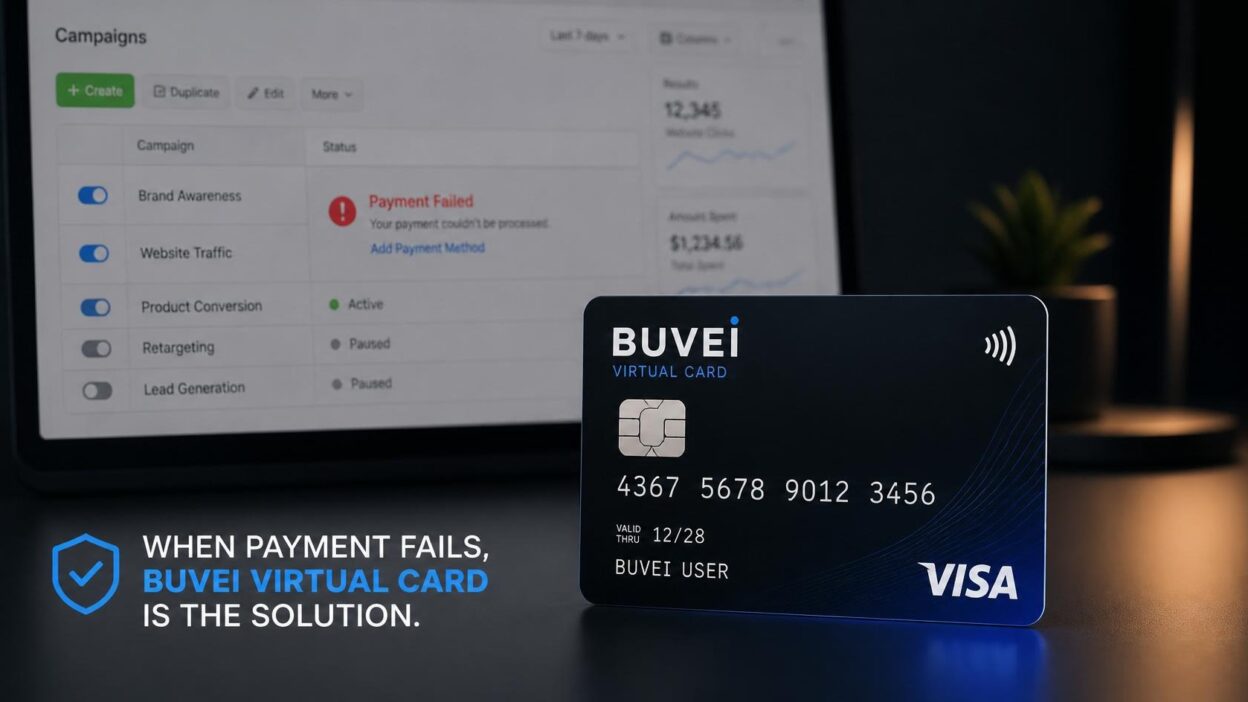
In Google Ads, Google Ads payment failed issues usually start in a way that feels almost routine.
A campaign is running normally. Spend is flowing. Ads are delivering without visible issues. Then, without much warning, Google Ads payment failed errors appear and Google Ads stops accepting the payment.
One retry fails. Then another. Sometimes the card still works in other platforms, but not inside Google Ads. In other cases, the account itself starts behaving differently—limited delivery, interrupted spend, or repeated billing prompts that never really resolve.
At that point, most advertisers are no longer optimizing campaigns. They are simply trying to keep Google Ads running.
And what makes it more frustrating is the lack of clarity. You only see messages like “Payment declined” or “Billing issue,” without any real explanation of what changed.
Why Google Ads Payment Failed Happens
When Google Ads payment failed, the first reaction is almost always the same: try another card, retry smaller payments, switch billing profiles, or contact support.
In some cases, this works temporarily. But in many real Google Ads payment failed situations, the issue returns quickly or shifts into another restriction.
The reason is simple: most fixes are targeting the symptom, not the system.
Inside Google Ads, payment approvals are not based only on card validity. They are influenced by accumulated account behavior, issuing patterns, and historical payment signals. This is why a card that works elsewhere can still fail inside Google Ads without any obvious reason.
Common Causes of Google Ads Payment Failed Errors
There are a few common reasons why Google Ads payment failed errors appear, even when the payment method seems fine outside the platform.
Sometimes it’s related to basic issues like insufficient funds, expired card details, or billing information that doesn’t fully match. In other cases, the issuing bank may reject the transaction due to online or cross-border restrictions.
It also happens that the card works normally on other platforms, but still fails specifically inside Google Ads.
Do Virtual Cards Fix Google Ads Payment Failed Issues?
At some point, many advertisers switch to virtual cards expecting stability.
Sometimes it helps briefly. But the pattern often repeats—initial success followed by inconsistent approvals during scaling or sudden payment declines.
The issue is not virtual cards themselves, but the environment behind them.
Some issuing sources behave inconsistently under Google Ads payment systems, especially when the same BIN ranges are widely used across advertising accounts. Over time, this creates unstable approval behavior that is hard to predict.
So the real problem is not “card type.” It is payment infrastructure consistency.
How to Fix Google Ads Payment Failed Errors
What usually works better is not constantly switching cards, but restructuring how payment methods are used across Google Ads accounts.
In more stable setups, payment methods are separated by account rather than reused across multiple campaigns or experiments. Once a billing setup shows instability, it is usually removed from scaling environments instead of being repeatedly tested.
The key shift here is simple: instead of forcing payment approval, advertisers start rebuilding a cleaner payment structure with less accumulated failure history.
This reduces noise inside Google Ads’ risk evaluation system and improves long-term stability for Google Ads payment failed cases.
Improving Google Ads Payment Stability with Virtual Cards
In structured Google Ads setups, virtual cards are not just payment tools. BUVEI functions more like an issuing infrastructure layer between Google Ads accounts and the payment network.
The main advantage comes from separating payment exposure across multiple Google Ads accounts instead of relying on a single billing identity. This reduces cross-account interference and helps maintain more stable payment behavior during scaling.
Most advertisers struggling with Google Ads payment failures are not lacking cards—they are lacking stable issuing infrastructure that can handle repeated ad payment activity.
BUVEI is built for this environment. Its multi-BIN issuing system is designed for Google Ads use cases where account separation, payment consistency, and scaling stability matter more than basic card functionality.
Instead of relying on random virtual cards that may behave unpredictably, BUVEI focuses on structured issuing logic to support more consistent Google Ads payment performance.
What experienced Google Ads advertisers focus on
Over time, experienced advertisers stop evaluating payment methods by surface-level features.
What matters more is consistency under real spending conditions.
BIN stability during scaling is more important than initial approval. Predictability over time matters more than one-time success. And behavior under repeated transactions becomes the real benchmark.
In practice, a stable but less flexible setup usually performs better than a feature-rich but unstable one.
How Google Ads payment setups are usually structured
In more mature Google Ads operations, payment methods are not treated as interchangeable.
A common approach is to separate billing sources by account rather than sharing them across everything. Testing environments are kept isolated from scaling environments. Once a stable setup is found, it is usually left unchanged unless there is a clear reason to adjust it.
The goal is not complexity. It is predictability under spend.
And once stability is achieved, most advertisers avoid unnecessary changes, since even small adjustments can reset payment behavior.
How Google Ads Payment Systems Evaluate Risk
Inside Google Ads, payment approval is influenced by more than just a single transaction.
The system looks at patterns over time, including how payments behave across different attempts, how stable the billing profile is, and whether the issuing source has consistent approval behavior.
Repeated declines, frequent changes in payment methods, or inconsistent billing signals can all contribute to higher risk evaluation inside the system.
Final Thoughts on Google Ads Payment Failed Issues
Google Ads payment failures rarely happen randomly.
They are usually the result of accumulated signals across billing attempts, account behavior, and issuing history.
That is also why quick fixes rarely last. The system is not reacting to a single transaction—it is reacting to a broader behavioral pattern that builds over time.
In most cases, the issue is not the card itself. It is how the payment structure has been built around Google Ads activity.
And once that structure becomes unstable, the solution is rarely another card. It is a more consistent and controlled payment system designed around how Google Ads actually evaluates risk.